
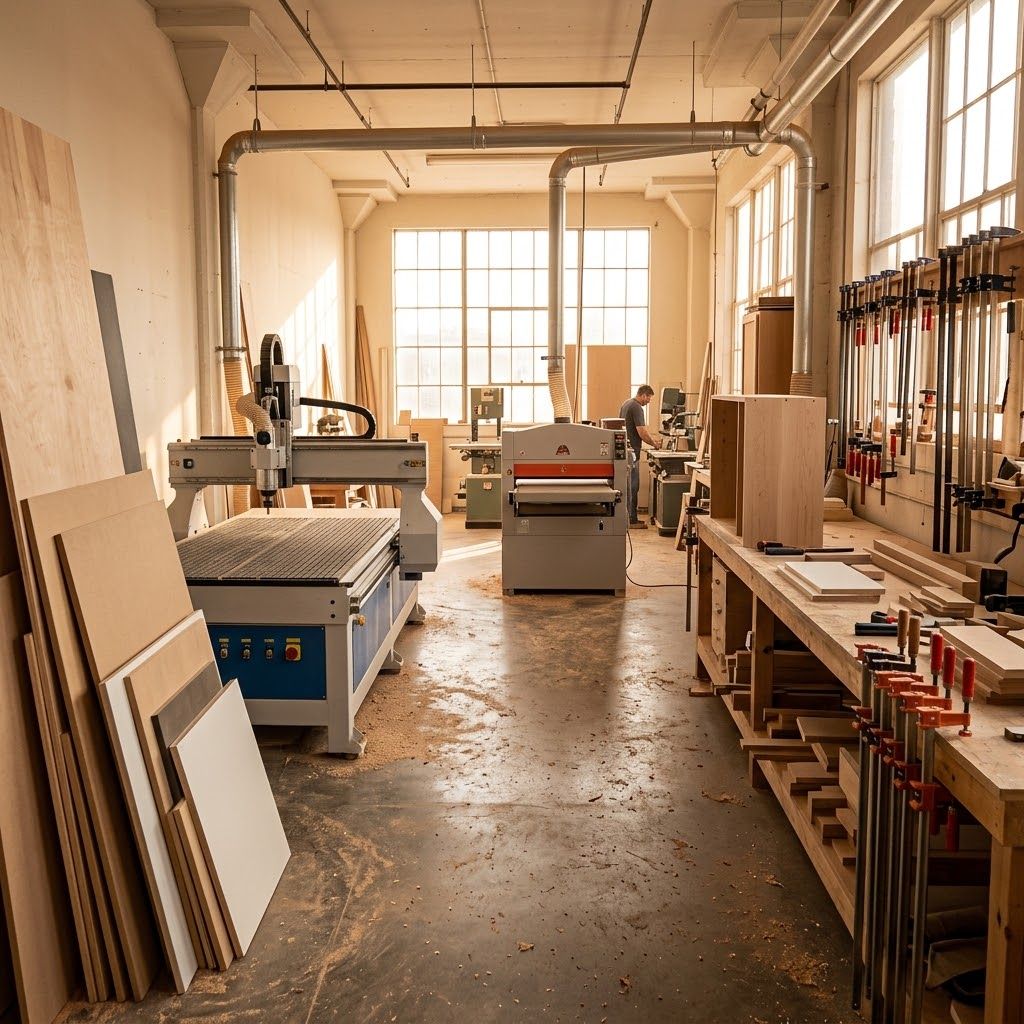
Woodworking equipment financing lets a cabinet, millwork, or furniture shop buy a CNC router, wide-belt sander, edgebander, or panel saw without paying the full price upfront. Because the machine typically secures the financing, lenders can evaluate the asset alongside your credit profile, cash flow, and operating history rather than requiring unrelated collateral.
That structure fits the way small shops actually grow. Once installed and commissioned, a CNC router can begin adding production capacity while its cost is spread across the financing term.
What Shops Finance
The machines that usually justify financing are the ones that change what a shop can quote on:
- CNC routers and nesting cells
- Wide-belt and drum sanders
- Edgebanders and case clamps
- Panel saws and beam saws
- Moulders, planers and shapers
- Dust collection, air handling and spray booths
- Software, tooling and installation tied to the machine purchase
Dust collection deserves particular attention. Shops often finance the router and then discover the existing collector cannot handle it. Quote the machine and the air system together so the lender can determine whether both can be included in the same financing package.
Need Funds Quickly?
Loan or Lease
An equipment loan means you own the machine from day one and repay over a set term. The debt appears on your balance sheet, and you take depreciation.
An equipment lease means the lessor owns the machine during the term. A dollar buyout lease behaves much like a loan and ends with you owning the equipment. A fair market value lease typically offers a lower payment than a comparable purchase-option lease and ends with a return, a renewal, or a purchase at the machine’s then-current value.
A loan or dollar-buyout structure can make more sense when you expect to keep the machine well beyond the financing term, while a fair market value lease can suit equipment you expect to replace. Many woodworking machines hold their usefulness for a long time, which is why shops often lean toward ownership structures.
What Lenders Look At
| Factor | Why it matters |
| Time in business and revenue | Shows the payment comes from operations, not projections |
| Machine type and age | Sets the term and how much of the price gets financed |
| New or used | Used machines may receive a lower advance percentage, larger down payment or shorter term |
| Dealer or private sale | Dealer invoices underwrite faster than private purchases |
| Installation and rigging | Often a cash cost outside the financed amount |
| Existing liens | May require payoff, subordination, an intercreditor agreement or a carve-out |
Used equipment is common in woodworking, where a twenty-year-old machine can still be worth buying. Our guide to equipment financing for used equipment explains how age and condition change what a lender will approve.
The Section 179 Question
Financing and tax treatment are separate decisions that interact. Section 179 lets a business expense qualifying equipment in the year it is placed in service rather than depreciating it over years.
The limits are generous relative to what a small shop spends. According to IRS Publication 946, the maximum Section 179 expense deduction for tax years beginning in 2026 is $2,560,000, reduced by the amount by which the cost of Section 179 property placed in service during the year exceeds $4,090,000. A shop buying a single CNC router sits far below both figures.
Financed equipment can qualify, which is the part shop owners often miss. You may be able to expense the machine in the year it goes into service while paying for it over several years. Your accountant will confirm how this applies to your return.
Financing With Weaker Credit
Woodworking equipment financing with bad credit is harder, not impossible. Lenders that underwrite on revenue and collateral value will look at a shop with a thin or damaged credit file, particularly when the machine has a strong resale market. A CNC router from a recognized manufacturer is easier to place than a custom-built machine.
Weaker credit may result in a higher down payment, shorter term, higher pricing, or a decline. Our guide to equipment financing with bad credit covers what those adjustments can look like.
Consistent recent deposits and a well-documented dealer invoice can strengthen an application, although underwriting priorities vary by lender. A handshake purchase from another shop gives an underwriter less to work with than an invoice from an established dealer.
💡 Pro Tip
The smartest funding decisions come from understanding the full cost, not just the monthly amount. Visit our guides for more exclusive tips.
Finance Woodworking Equipment with Delta Capital Group
Delta Capital Group provides unsecured working capital from $5,000 to $5,000,000 to business owners across the country, along with equipment financing structured around the equipment’s useful life. No collateral required beyond the equipment for most equipment financing. Approvals happen in as little as 24 hours, and 95 percent of approved applicants are funded within 48 hours. Minimum qualifications are 6 months in business, $15,000 in monthly revenue, and a 500 credit score. Apply at deltacapitalgroup.com.
Frequently Asked Questions
Can a small cabinet shop finance a CNC router?
Yes. Shop size matters less than revenue and the machine itself. A router from an established manufacturer has a clear resale market, which can strengthen the collateral profile and give the lender a recovery path.
Does financing cover installation and rigging?
Freight, rigging, and installation may be financeable depending on the program. Electrical upgrades, concrete work, and dust collection ducting may or may not qualify, so confirm exactly what the financed amount includes before the machine ships.
Can I finance used woodworking machinery?
Yes, though terms differ. A used machine may receive a lower advance percentage, a larger down payment or a shorter term, depending on age, condition, lender, and borrower. A documented service history and a dealer invoice both improve the outcome.
What credit score do I need?
It depends on the lender. Bank and captive programs look for strong credit. Delta publishes a 500 FICO minimum alongside six months in business and $15,000 in monthly revenue, subject to underwriting. Your credit profile can still affect approval, pricing, down payment, and other terms.
How long are the terms?
Terms are set against the machine’s expected working life. The exact term depends on whether the machine is new or used, its condition, and the lender’s program. Longer terms lower the payment and raise total interest.

