
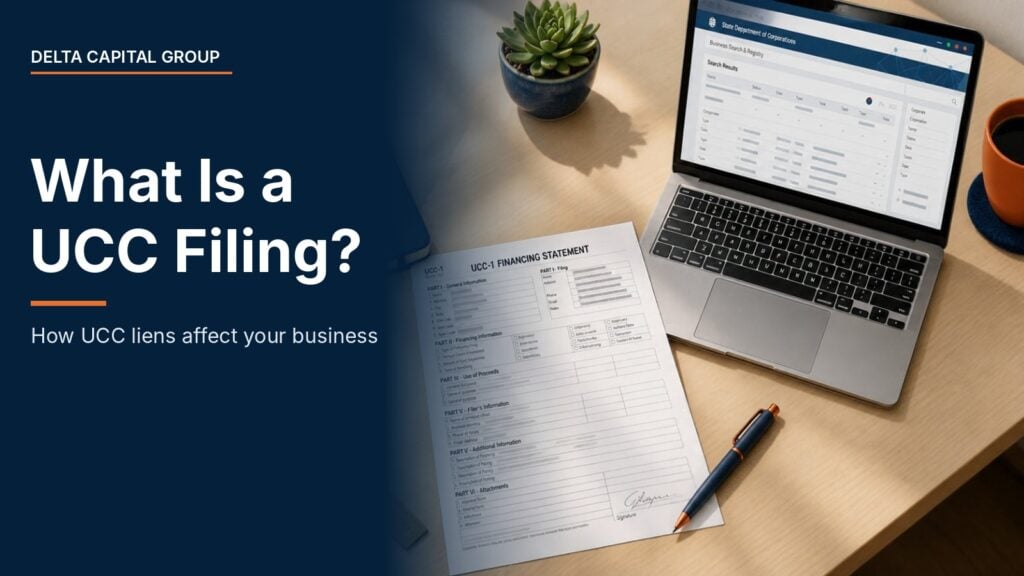
A UCC filing is a public notice that a lender has a claim on some or all of a business’s assets. If you’ve taken business funding, there’s a good chance one has been filed against your company, often without you noticing. It can affect whether you get approved for more funding, so it’s worth knowing how they work.
This guide covers what a UCC filing is, why lenders file them, how to find the ones against your business, and how to get one removed.
What a UCC filing is
UCC stands for the Uniform Commercial Code, a set of business laws that every state has adopted in some form. Article 9 of the code covers loans and other deals backed by personal property, like equipment, inventory, receivables and cash.
When a lender takes a security interest in a business’s assets, it files a form called a UCC-1 financing statement, usually with the Secretary of State in the state where the business is registered. The filing doesn’t move any money or take any property. It puts the world on notice that this lender has a claim, and it sets the lender’s place in line if the business can’t pay its debts.
People call it a UCC filing, a UCC lien or a UCC-1. They all mean the same thing.
Why lenders file them
- To get in line first. In most cases, the first lender to file has the first claim on the collateral if the business defaults or goes bankrupt.
- To protect their collateral. An equipment lender wants a clear claim on the machine it paid for.
- Because it’s standard. Banks, SBA lenders, equipment lenders, factoring companies and most merchant cash advance funders file UCCs. It’s routine and doesn’t mean anything is wrong.
Types of UCC filings
| UCC-1 | The original financing statement that creates the public record. |
| UCC-3 amendment | Changes an existing filing, such as a new address, added collateral or a different lender. |
| UCC-3 continuation | Extends a filing for another 5 years. It has to be filed in the 6 months before the original lapses. |
| UCC-3 termination | Ends the filing once the debt is paid off. |
Blanket liens vs. specific collateral
The collateral description on the filing makes a big difference.
- Specific collateral. The filing lists a particular asset, like “one 2024 Caterpillar 320 excavator, serial number …” The lender’s claim stops there. This is common with equipment financing and vehicle loans.
- Blanket lien. The filing covers “all assets” of the business, sometimes listed out as accounts, inventory, equipment, deposit accounts and general intangibles. Many working capital lenders and MCA funders use blanket liens, since there’s no single asset backing the deal.
A blanket lien is the one that matters most when you apply for more funding. A second lender sees that someone else already has first claim on everything you own.
How a UCC filing affects your business
- It shows up on business credit reports. Dun & Bradstreet, Experian Business and Equifax business reports list UCC filings. It doesn’t appear on your personal credit report or lower your personal score.
- It can make new funding harder. Lenders search UCC records before approving you. A blanket lien from another lender may mean a smaller offer, a request for a payoff, or a decline. See taking two MCAs at once.
- It can complicate factoring. Factoring companies need a clear claim on your receivables. An existing blanket lien usually has to be released or subordinated first. More in factoring with an existing UCC lien.
- It can come up when you sell the business. A buyer will want every lien cleared before closing.
A UCC filing isn’t a bad mark by itself. A paid-off debt with a terminated UCC shows you’ve borrowed and repaid, which lenders like to see.
How to look up UCC filings on your business
- Go to the Secretary of State website in the state where your business is registered. Most have a free online UCC search. Florida, for example, uses the Florida Secured Transaction Registry.
- Search by your exact legal business name as it appears on your formation documents. Try variations with and without “Inc,” “LLC” and punctuation.
- Read each filing. Note the secured party (the lender), the filing date and the collateral description.
- Check your business credit reports as well, since they often pull filings from several states.
It’s worth doing this before you apply for new funding, so you aren’t surprised by a filing from a lender you paid off years ago.
How long a UCC filing lasts
A UCC-1 is generally effective for 5 years from the date it’s filed. After that it lapses on its own unless the lender files a continuation. Some filings, like those tied to certain real estate or public finance deals, follow different rules, but for a typical small business loan or advance, 5 years is the number to remember.
How to get a UCC filing removed
Once your debt is paid, the lender should file a UCC-3 termination. Many don’t do it on their own, so it’s up to you to ask.
- Pay off the balance in full and get a payoff letter or zero-balance letter in writing.
- Send the lender a written request to file a UCC-3 termination. Under the UCC, once the debt is paid and you’ve sent a proper written demand, the lender generally has 20 days to file the termination or send it to you to file.
- Check the state database a few weeks later to confirm the filing shows as terminated.
- Keep copies of the payoff letter and termination for your records.
If the lender still doesn’t act after a proper written demand, the UCC generally lets you file the termination yourself. A business attorney can help if it comes to that.
If you’re still paying the debt and need new funding, you have other options. A new lender may pay off the old one as part of the deal, or the old lender may agree to subordinate its claim. Refinancing is often the simplest route. See refinancing a merchant cash advance and MCA consolidation.
Can you get funding with a UCC lien on your business?
Yes. Plenty of businesses with active UCC filings get approved every day. What matters is how much you still owe, how your payments have gone and whether your revenue can support another payment. At Delta, an existing UCC filing doesn’t rule you out. We look at your bank statements and the full picture. We generally look for 6 months in business, $15,000 or more in monthly revenue and credit from 500, and we fund from $5,000 to $5 million.
Common questions
Does a UCC filing hurt my personal credit?
No. UCC filings appear on business credit reports, not personal ones. A personal guarantee is a separate matter.
Is a UCC lien the same as a tax lien?
No. A UCC filing comes from a deal you agreed to. A tax lien is filed by the IRS or a state over unpaid taxes and is much more serious for lenders.
Can a lender take my assets just because it filed a UCC?
Not by itself. The filing only gives notice of the lender’s claim. Collection on collateral follows a default under your contract and the law.
Why is there a UCC filing from a lender I never worked with?
Filings sometimes come from a broker’s lender, a company that bought your account, or a mistake. Contact the secured party listed. If it’s an error, ask for a termination.
Does every business loan come with a UCC filing?
Not every one, but most secured loans, equipment financing, factoring agreements and merchant cash advances do.
What owners say about us
Excellent, very professional service, I highly recommend it
 Adrian Venturain the last week on Google
I operate a few fast-paced businesses. Opportunities and corresponding growth-related expenses sometimes create immediate funding needs. Mitch has personally navigated my businesses through many of these situations. I consider him to be a straight sh…
 Farra Shawin the last week on Google
Kyle and the lenders helped us immediately and got us to where we are now moving in a forward direction.
 Management Patriot Bara week ago on Google

Benjamin Miller is a Senior Funding Advisor at Delta Capital Group with more than eight years of experience. He works mostly with term loans, lines of credit and equipment financing, and helps owners pick the option that fits how their business actually brings in money. More about Benjamin