
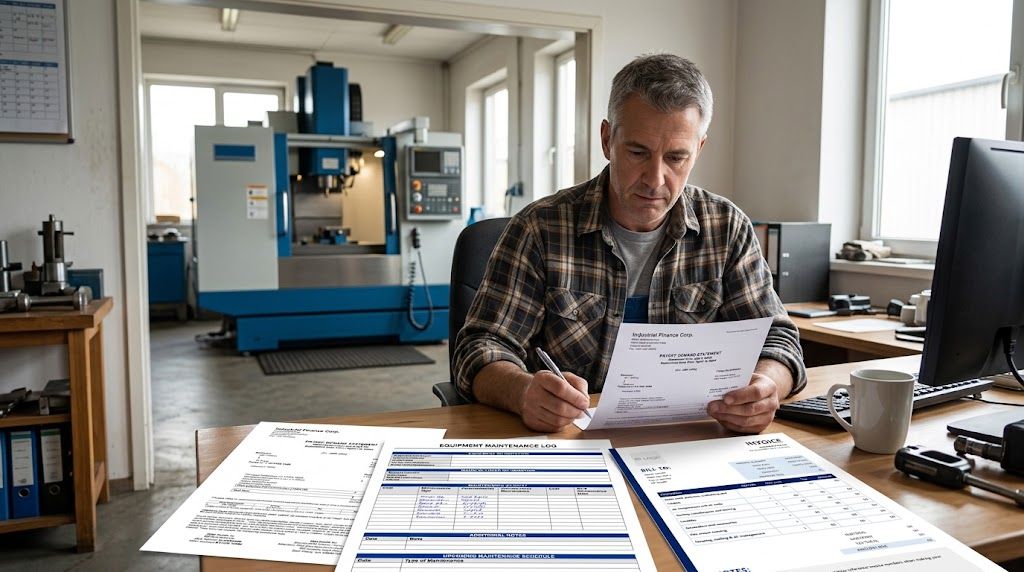
Refinancing an equipment loan means replacing an existing loan on a machine, vehicle or system with new financing on different terms. A new lender pays off the old balance, and you begin repaying the new lender under a revised rate, term, or payment schedule.
Two different transactions travel under the same word, and they solve different problems. Sorting out which one you need is the first step, because the paperwork, the pricing, and the qualifying criteria all diverge from there.
Payoff Refinancing Versus Cash-Out Refinancing
Payoff refinancing replaces the existing loan and nothing more. The new lender pays the current balance, takes the lien position, and you get a different rate, a longer term, or both. Nobody hands you money. The point is a lower monthly payment or an escape from a balloon coming due.
Cash-out refinancing uses equipment you already own, free and clear or nearly so, as collateral for new borrowing. The lender values the machine, advances a percentage of that value, and you keep the proceeds as working capital. A related alternative is a sale-leaseback, where you sell the equipment to the funder and lease it back.
Both are worth considering for different reasons. If your problem is the payment, payoff refinancing addresses it. If your problem is that capital is tied up in machinery, cash-out addresses that instead. Confusing the two wastes an application cycle.
💡 Pro Tip
The smartest funding decisions come from understanding the full cost, not just the monthly amount. Visit our guides for more exclusive tips.
How the Process Works
- Pull the payoff quote. Ask your current lender for a written payoff figure good through a specific date, plus any prepayment penalty. This number drives everything downstream.
- Value the equipment. The new lender lends against current market value, not against what you paid. Gather serial numbers, hours or mileage, service records, and the original invoice.
- Check the lien. A lien or UCC search and the existing loan documents help establish what security interests cover the equipment. For some titled property, certificate-of-title law governs perfection instead of a UCC filing. A blanket lien from an unrelated lender can block the deal until it is released or subordinated.
- Apply with two or three lenders. Approval is not a formality. In the Federal Reserve’s 2026 Report on Employer Firms, drawn from the 2025 Small Business Credit Survey, 42 percent of applicants received the full amount of financing they sought, 36 percent received some or most, and 22 percent received none.
- Compare total cost, not payment. A longer term lowers the payment and raises the interest paid over the life of the loan.
- Close and confirm the release. Where the old lender perfected its lien through a UCC filing, confirm that the appropriate termination or amendment is filed after payoff. An unreleased stale lien causes trouble on your next financing application.
What Refinancing Costs
| Cost | What to expect |
| Prepayment penalty on the old loan | A major variable, sometimes a percentage of the balance, sometimes remaining interest |
| Documentation and origination fees | Charged by the new lender at closing |
| UCC filing and search fees | Small, but charged per filing and per state |
| Appraisal or inspection | More common on cash-out and on older equipment |
| Additional interest from a longer term | The cost of the lower payment |
Prepayment terms decide whether refinancing makes sense at all. Some equipment loans carry no penalty. Others make an early payoff expensive enough to wipe out the savings. Read that clause before you apply anywhere.
Where Businesses Refinance
Banks may offer lower pricing but often use stricter underwriting and longer processes. Independent equipment-finance companies may have more flexibility on asset age and credit profile. Manufacturer captives generally finance their own brand and are less likely to refinance another lender’s paper. Alternative lenders often weigh revenue and collateral heavily, which can matter when speed is the priority.
If the equipment is older, age rules will shape what is available. Our guide to equipment financing for used equipment explains the remaining useful life tests lenders apply.
When Refinancing Does Not Work
Refinancing fails for predictable reasons. If the equipment’s value is below the payoff balance, a lender may not refinance the full balance without additional cash or collateral. The remaining useful life may be shorter than the term you want. The prepayment penalty exceeds the savings. Or the underlying issue is working capital rather than the equipment payment, in which case a working capital loan addresses the problem more directly than restructuring a machine loan.
Refinance Equipment with Delta Capital Group
Delta Capital Group provides unsecured working capital from $5,000 to $5,000,000 to business owners across the country, along with equipment financing structured around the equipment’s useful life. No collateral required beyond the equipment for most equipment financing. Approvals happen in as little as 24 hours, and 95 percent of approved applicants are funded within 48 hours. Minimum qualifications are 6 months in business, $15,000 in monthly revenue, and a 500 credit score. Apply at deltacapitalgroup.com.
Frequently Asked Questions
Can I refinance equipment I have already paid off?
Yes. That is cash-out refinancing, and owning the asset outright is the strongest position to do it from. The lender values the equipment, advances a percentage of that value, and takes a lien. Age, condition and resale market determine the advance.
Does refinancing hurt my credit?
A refinancing application may involve a hard credit inquiry, while some lenders use a soft inquiry for prequalification. A new loan may also be reported depending on the lender and credit bureau. Ask how the lender checks and reports credit before applying.
How long does equipment refinancing take?
Timing varies widely. A transaction can take longer when the new lender needs an appraisal, payoff statement, title work, lien release, or additional underwriting. Gathering the payoff letter and lien release from the existing lender is often the slowest step rather than the credit decision itself.
What if my equipment is worth less than I owe?
A lender may not refinance the full balance without additional cash or collateral. Options are paying the difference in cash, adding other collateral, or waiting until the balance falls below market value.
Is refinancing the same as a sale-leaseback?
No. They can solve similar liquidity needs, but the structures differ. A sale-leaseback transfers title to the funder and leases it back, while a cash-out refinance leaves title with you and places a lien. Tax and accounting treatment differ, so confirm with your accountant.

