
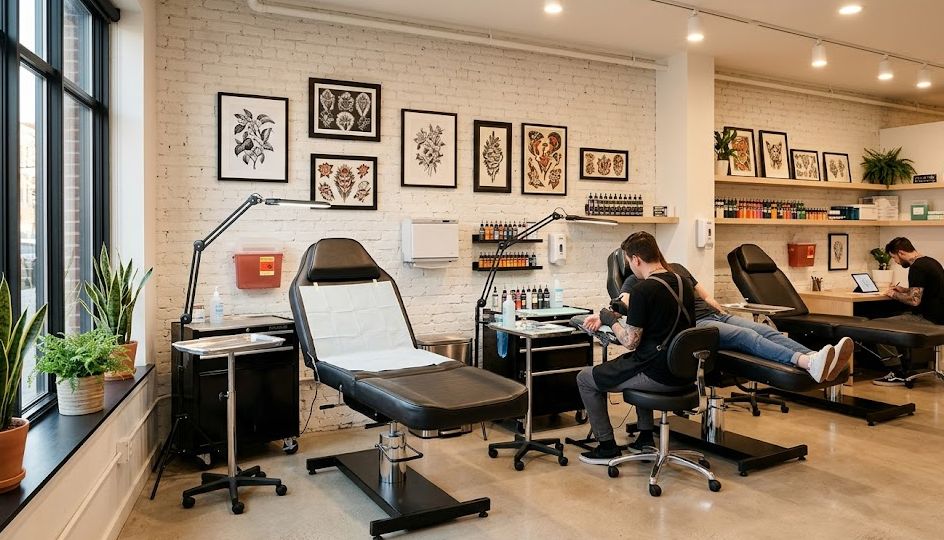
Opening a tattoo shop typically costs between $15,000 and $75,000, with most single-location studios landing somewhere around $25,000 to $50,000.
A small two-artist shop in an affordable market can open near the low end, while a larger studio in a high-rent city with a full buildout can run past $75,000. The biggest variables are your lease and buildout, the number of stations you set up, and how much equipment you buy new versus used.
Compared to most brick-and-mortar businesses, a tattoo shop is relatively inexpensive to start, but licensing, health compliance, and slow early months still demand real capital.
Here’s where it goes.
Tattoo Shop Startup Costs at a Glance
A typical single-location studio breaks down like this:
| Expense | Typical Range |
| Lease deposit and buildout | $5,000 to $30,000 |
| Tattoo stations and furniture | $3,000 to $12,000 |
| Tattoo machines and equipment | $2,000 to $8,000 |
| Autoclave and sterilization | $2,000 to $6,000 |
| Licenses and permits | $500 to $5,000 |
| Initial supplies (ink, needles, PPE) | $2,000 to $6,000 |
| Insurance (initial) | $500 to $2,000 |
| POS and booking software | $500 to $2,000 |
| Working capital (3 to 6 months) | $8,000 to $25,000 |
Totals commonly land between $24,000 and $50,000 for a standard shop, with lean setups opening for less and premium studios running higher.
Need Funds Quickly?
The Biggest Cost Drivers
Three decisions move your budget more than anything else.
Location and buildout. Rent and renovation are the largest line items for most shops. A second-generation space that already has plumbing near each station, good ventilation, and a reception area can save tens of thousands over a raw retail space that needs everything built from scratch. Tattoo studios need sinks, proper waste handling, and a layout that separates the sterilization area from the work floor, so plumbing access matters more than square footage alone.
Number of stations. Each additional artist station adds equipment, furniture, and buildout cost, but also adds earning capacity. Many owners open with two or three stations and expand as demand grows.
New versus used equipment. Autoclaves, chairs, and furniture can often be bought used at a substantial discount. Machines and anything that touches a client should be new and reputable, but the durable fixtures are fair game for savings. Lenders finance shop equipment routinely, and our guide to equipment financing for used equipment explains how used purchases get funded.
Licensing and Health Compliance
This is the line owners underestimate most. Tattoo regulation is handled at the state and county level, and requirements vary widely. Expect some combination of:
- A shop or establishment license from your local health department
- Individual artist licenses or registrations
- Bloodborne pathogen certification for every artist
- Facility inspections before opening and periodically after
- Sharps disposal and biohazard waste contracts
Build in time as well as money. In some jurisdictions, inspections and approvals take weeks, and signing a lease before you confirm the space can be permitted is a costly mistake. Confirm local rules before you commit to a location.
What Tattoo Shops Earn
The demand side has been strong. Tattoo artistry is a $1.3 billion industry in 2026 according to IBISWorld, spread across roughly 23,800 businesses, and the sector grew at a double-digit annual rate over the prior five years. Revenue per shop varies enormously with location, artist reputation, and how many stations stay booked, but the low overhead relative to other storefronts is part of what keeps well-run studios profitable.
Many shops also run on a booth-rental model, where artists pay the shop a weekly or monthly fee for their station rather than splitting each tattoo. That structure can stabilize the shop’s revenue and lower its payroll risk, which matters when you’re projecting how quickly you’ll cover fixed costs.
Financing a Tattoo Shop
Most owners don’t fund a shop from savings alone. The equipment portion, from autoclaves to stations, fits naturally with equipment financing, where the gear itself secures the loan. The softer costs, including buildout, supplies, licensing, and the lean opening months, are better matched to a business line of credit you draw against only as needed. Keeping some borrowing capacity in reserve for the first slow season is one of the smarter moves a new shop owner can make.
Delta Capital Group Funds Tattoo Shops Nationwide
Delta Capital Group is a direct funder, not a broker, and provides unsecured working capital from $5,000 to $5,000,000 for tattoo shops and studios across the country. No collateral required. Approvals happen in as little as 24 hours, and 95 percent of approved applicants are funded within 48 hours. Minimum qualifications are 6 months in business, $15,000 in monthly revenue, and a 500 credit score. Apply at deltacapitalgroup.com.
Frequently Asked Questions
Is a tattoo shop profitable?
It can be. Tattoo shops carry low overhead compared to most storefronts, and studios that keep their stations booked, build artist reputations, and control rent typically run healthy margins. Booth-rental models can further stabilize revenue by shifting income to predictable station fees.
How much do tattoo artists charge?
Pricing varies widely by market and artist, set either by the hour or by the piece. What matters for a shop owner is station utilization: revenue depends far more on how consistently your chairs stay booked than on any single price point.
Do you need a license to open a tattoo shop?
Yes. Nearly every jurisdiction requires a shop or establishment license plus individual artist licenses, bloodborne pathogen certification, and health department inspections. Requirements are set at the state and county level, so confirm your local rules before signing a lease.
Can you open a tattoo shop with bad credit?
Yes. Traditional banks get difficult below a 650 FICO score, but equipment financing uses the gear as collateral, and direct funders approve owners with scores as low as 500 when the business shows 6 months of operating history and $15,000 in monthly revenue.
How long does it take to open a tattoo shop?
Plan on a few months from signing a lease to opening day. Buildout, equipment installation, and especially health department permitting and inspections drive the timeline, and approvals can take several weeks depending on your jurisdiction.

