
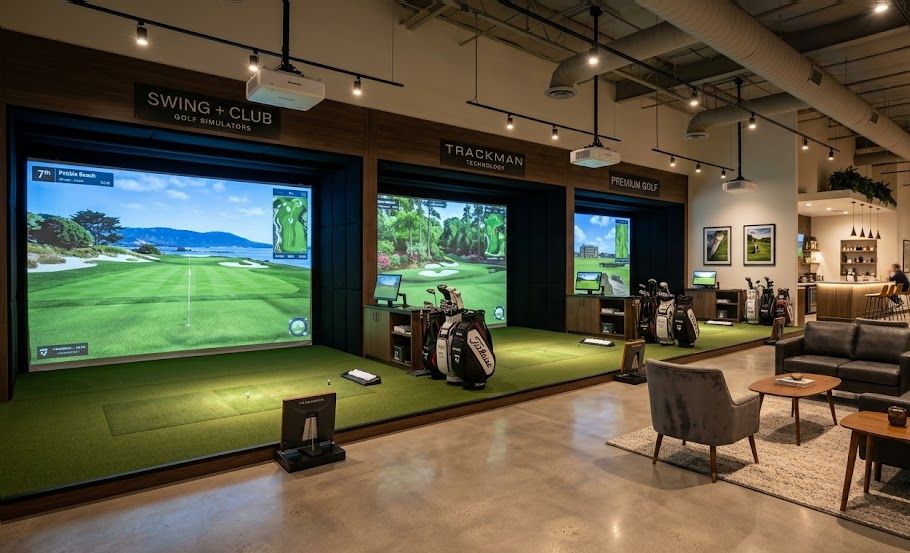
Starting a golf simulator business typically costs between $150,000 and $600,000, with a small two-bay lounge coming in near the low end and a six-bay venue with a premium build-out pushing well past it. The three variables that move the number most are how many bays you install, which tier of launch monitor technology you choose, and how much construction your space needs. Anyone learning how to start a golf simulator business should price those three decisions first, because everything else in the budget is small by comparison.
What Each Simulator Bay Costs
A complete commercial bay includes a launch monitor, simulation software, an enclosure with an impact screen, a projector, hitting mats, and a computer to run it all. Fully assembled, commercial-grade bays generally run $25,000 to $70,000 each. The launch monitor drives the spread. Mid-tier commercial units run roughly $5,000 to $20,000, while tour-grade systems can cost $15,000 to $50,000 or more on their own. Venues aimed at serious golfers and lessons tend to buy up; venues aimed at social groups can buy mid-tier and spend the difference on the room.
Software is a recurring line, with commercial licensing for course libraries and multiplayer features commonly running $1,000 to $3,000 per bay per year.
Space, Build-Out, and the Rest of the Budget
An indoor golf simulator business needs ceiling height before anything else. Plan on at least 10 feet, with more preferred, so golfers can swing a driver safely. Each bay wants roughly 250 to 400 square feet once you include the hitting area and seating, which puts a four-bay venue with a lounge in the 2,000 to 4,000 square foot range.
Build-out typically runs $50,000 to $150,000 depending on the condition of the space, covering flooring, electrical, lighting, seating, sound, and a service counter. Add furniture, a booking and point-of-sale system, signage, insurance, and a working capital reserve for the first slow months. Here is how the tiers commonly stack up:
| Venue size | Typical all-in startup cost | Best fit |
| 2 bays, boutique | $120,000 to $250,000 | First location, lesson-focused, small market |
| 4 bays, standard | $250,000 to $450,000 | Full evening and league traffic |
| 6 or more bays, premium | $450,000 to $800,000+ | Entertainment venue with bar service |
How Simulator Venues Make Money
Hourly bay rental is the core, with most markets supporting $40 to $70 per hour per bay. The venues that perform build recurring revenue on top of it: monthly memberships, winter leagues, lessons, and corporate events that book multiple bays at once. Demand also runs opposite the golf calendar, since bays fill when the weather empties the courses, which smooths revenue across the year in most climates.
The category has real momentum behind it. U.S. golf driving ranges and family fun centers industry reached $23.9 billion in 2026 across more than 22,600 businesses, reflecting how much golf and recreation spending has moved into off-course venues.
Need Funds Quickly?
Independent or Franchise?
Franchise systems sell a proven layout, vendor pricing, and marketing support in exchange for an upfront fee and ongoing royalties. Independent operators keep the full margin and control the concept, but source their own equipment and learn pricing the hard way. There is no wrong answer, though the math differs: franchise fees effectively add to the startup total, while independence adds risk to the first year. Either way, the equipment list is nearly identical, and so is the financing approach.
Financing the Build
The equipment-heavy budget is actually an advantage when it comes to funding, because simulators, launch monitors, and build-out fixtures can be financed with the equipment itself serving as collateral through equipment financing. A used market exists for launch monitors and enclosures as venues upgrade, and our guide to equipment financing for used equipment covers how lenders treat pre-owned gear. For the ramp-up months, a business line of credit covers payroll and marketing while memberships build, with interest owed only on what you draw.
Imagine an owner opening a four-bay venue at $320,000 all-in. Financing $180,000 of equipment over five years, funding $80,000 of build-out with a short-term loan, and reserving cash for operations turns one impossible check into three manageable ones, each matched to what it pays for.
Finance Your Golf Simulator Business with Delta Capital Group
Delta Capital Group provides unsecured working capital from $5,000 to $5,000,000 to business owners across the country. No collateral required beyond the equipment for most equipment financing. Approvals happen in as little as 24 hours, and 95 percent of approved applicants are funded within 48 hours. Minimum qualifications are 6 months in business, $15,000 in monthly revenue, and a 500 credit score. Apply at deltacapitalgroup.com.
✓ 6+ months in business
✓ $15,000+ monthly revenue
✓ Active business bank account
Frequently Asked Questions
How much does one golf simulator bay cost?
A complete commercial bay typically costs $25,000 to $70,000 including the launch monitor, enclosure, screen, projector, mats, software, and computer. The launch monitor tier drives most of the difference, with tour-grade units alone running $15,000 to $50,000 or more.
Are golf simulator businesses profitable?
Venues that pair $40 to $70 hourly bay rates with memberships, leagues, and lessons can reach strong margins, because the labor needs are light and demand peaks in the off-season months when courses close. Utilization is the deciding factor, which makes location and programming matter more than bay count.
How much space do you need for a golf simulator business?
Plan roughly 250 to 400 square feet per bay plus lounge space, with ceilings of at least 10 feet so players can swing freely. A four-bay venue with seating generally fits in 2,000 to 4,000 square feet.
Can you finance golf simulators?
Yes. Simulators and launch monitors qualify for equipment financing, with the equipment serving as its own collateral, and both new and used systems can be financed. Many owners combine equipment financing for the bays with a short-term loan or line of credit for build-out and operating reserve.
Do you need golf experience to run a simulator venue?
Operating experience matters more than a scratch handicap. Owners succeed by managing bookings, memberships, and events well, and many hire a teaching pro for lessons rather than providing instruction themselves.

