
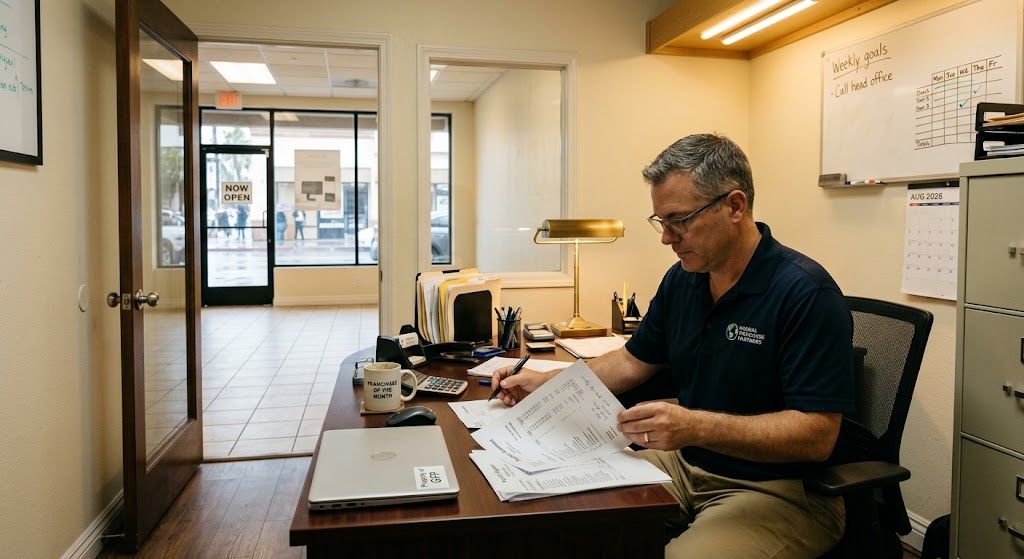
Working capital for franchisees is short term funding used to run a franchise location that is already open, covering payroll, inventory, royalty and marketing fees, equipment repair, and the gaps between strong and weak trading months. It is a separate question from the money used to buy the franchise in the first place. Most franchisees arrange purchase financing once and then spend the next several years managing operating cash flow, which is the part nobody prepares them for.
The distinction matters because the two needs behave differently. Purchase financing is a larger, one-time acquisition or pre-opening need, often covering franchise rights, goodwill, build-out and other startup costs rather than a single defined asset. Operating capital is recurring, smaller, and time sensitive. A franchisee who needs $40,000 to cover payroll and a royalty payment three weeks from now is solving a different problem than one raising $400,000 to acquire a territory.
- 6+ months in business
- $15,000+ monthly revenue
- Active business bank account
Why franchise operations create their own cash flow pressure
Franchising is a large and stable part of the U.S. economy. The International Franchise Association projects 845,000 franchise establishments in 2026, up from 832,521, supporting nearly 8.9 million jobs. Stability at the system level, though, does not smooth out cash flow at the unit level, and several features of the franchise model actively work against it.
Royalty and marketing fund payments are typically calculated on gross sales and collected weekly or monthly by automatic debit, regardless of whether the location was profitable that period. A franchisee having a bad month still pays the same percentage.
Brand standards limit the usual cost levers. An independent operator facing a slow quarter can switch suppliers, cut a menu item, or delay a refresh. A franchisee often cannot, because approved suppliers, required equipment, and refresh schedules are contractual. The costs that an independent business would trim are the ones a franchise agreement holds fixed.
Mandatory remodels arrive on the franchisor’s timetable. Many agreements require a refresh every five to seven years or at renewal, frequently costing $75,000 to $400,000 depending on the concept. The date is known well in advance, which is precisely why it should be planned for rather than absorbed as a shock.
What franchisees actually fund
In practice, operating capital requests from franchisees cluster into a handful of uses.
Payroll bridging is the most common, particularly for concepts with heavy weekend or seasonal staffing. Inventory builds ahead of a promotional period come next, since national campaigns are scheduled by the franchisor and the franchisee carries the stock. Equipment repair and replacement is a third, and it is rarely optional, because a failed unit in a food or service concept can close the location.
Then there is multi unit expansion working capital. A franchisee opening a second or third location often finds that the new unit consumes cash for six to twelve months while the established unit is expected to carry it.
| Need | Typical timing | Common funding fit |
| Payroll gap | Days | Line of credit |
| Inventory ahead of a promotion | 2 to 8 weeks | Short term loan or line of credit |
| Equipment failure | Immediate | Equipment financing |
| Mandatory remodel | Known years ahead | Planned term financing |
| Second unit ramp | 6 to 12 months | Working capital against the performing unit |
How funders assess a franchisee
Underwriting a franchise location differs from underwriting an independent business in a few useful ways.
Franchise systems generate comparative data. A funder can often see how a concept performs across many units, which reduces uncertainty about the business model itself and shifts the question toward this operator and this location. A well known concept with a long operating history is easier to assess than a novel independent business with the same revenue.
The franchise agreement itself gets read. Transfer restrictions, term remaining, and any franchisor consent requirements affect what a funder is willing to do. A franchisee with eighteen months left on an agreement and no confirmed renewal presents differently than one with nine years remaining.
Revenue consistency carries the most weight. For most short term products, recent deposit history matters more than credit score, which is why franchisees with credit damaged by a difficult opening period can still qualify once the location is trading steadily.
A note on structure. Imagine a franchisee whose agreement requires the franchisor’s written consent before pledging assets or taking on certain debt. That clause does not necessarily rule out funding, but it may require franchisor consent before anything can close, which means the conversation with the funder and the conversation with the franchisor need to happen in the right order.
Fund Your Franchise Operations with Delta Capital Group
Delta Capital Group provides unsecured working capital from $5,000 to $5,000,000 to business owners across the country. No collateral required. Approvals happen in as little as 24 hours, and 95 percent of approved applicants are funded within 48 hours. Minimum qualifications are 6 months in business, $15,000 in monthly revenue, and a 500 credit score. Apply at deltacapitalgroup.com.
Franchisees managing recurring gaps often prefer a business line of credit they can draw against repeatedly, while those funding a defined one time need tend toward a short term loan. If you are weighing which structure fits, our guide to choosing the right business loan walks through the trade-offs.
Frequently asked questions
What is working capital for a franchisee? It is short term funding used to operate an existing franchise location, covering payroll, inventory, royalty payments, repairs, and seasonal gaps. It is separate from the financing used to purchase the franchise.
Can a franchisee get funding without the franchisor’s involvement? Often yes for unsecured working capital, though many franchise agreements contain consent clauses covering debt or asset pledges. Read your agreement before applying, and raise anything ambiguous with the franchisor early.
How much working capital should a franchise location hold? A common guideline is three to six months of fixed costs, including rent, payroll, and royalty obligations. Concepts with sharp seasonality generally need the higher end of that range.
Do franchisees qualify for funding with bad credit? Revenue based products weight recent bank deposits more heavily than credit score. Delta’s stated minimum is a 500 FICO alongside 6 months in business and $15,000 in monthly revenue, subject to underwriting.
Is funding a remodel different from funding operations? Yes. A mandatory remodel is a large, scheduled expense better matched to planned financing, while operating gaps suit revolving or short term products. Mixing the two tends to leave the location short during the build.
What owners say about us
Huge thank you to Ruben Davis and Delta Capital Group! Ruben stepped in, helped me navigate everything, and secured the funds I needed right on time. Quick turnaround, clear communication, and completely reliable. If you need working capital without…
 David Goldman2 weeks ago on Google
One of the most honest trusted and appreciated company I know so far. They took the time and vision to help a situation. And form great relationships with their clients. Thanks for always being there for my business
 Buffet Kreyol2 weeks ago on Google
It has been a pleasure working with Dov as my lender. He is knowledgeable, trustworthy, and always willing to help. I have worked with him for almost two years, and his professionalism and commitment to excellent service have been outstanding. I high…
 Alejandro Chavez5 months ago on Google

Allen White is a Managing Partner at Delta Capital Group with more than 30 years in financial services. He started his career on Wall Street and left it to work directly with small business owners, and he still talks with owners himself about what kind of funding makes sense for them. More about Allen