
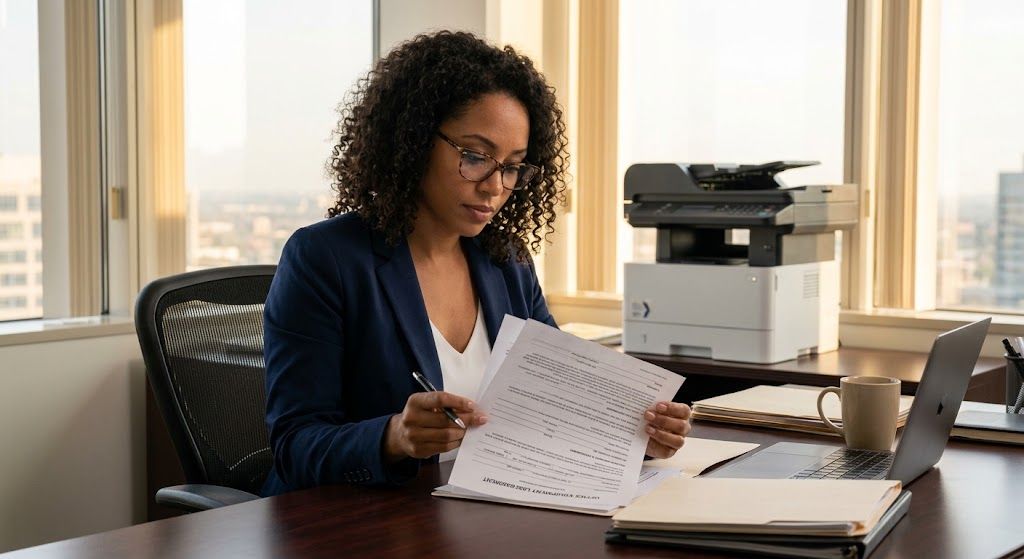
Office equipment leasing lets a business use copiers, printers, phone systems, servers, and furniture for a fixed monthly payment instead of buying them outright. The leasing company owns the equipment during the term. You pay for the use of it, and at the end you either return it, renew, or buy it, depending on which structure you signed.
Terms usually run 36 to 60 months. The payment depends on the equipment cost, the term, your credit profile, and which of the three common lease structures applies.
What Office Equipment Leasing Covers
Most office leases are written for assets that lose value quickly or get replaced on a predictable cycle:
- Copiers, multifunction printers and production print equipment
- Computers, laptops, servers and network hardware
- VoIP phone systems and conference room technology
- Point of sale terminals and back office systems
- Desks, chairs, cubicles and other office furniture
- Security cameras, access control and alarm systems
Software and service contracts are often bundled into the same payment. That bundling is convenient, and it also makes lease quotes harder to compare, because two proposals with the same monthly figure can contain very different amounts of hardware.
The Three Lease Structures
This is the part that decides what you actually pay over the full term, and it is the first question to ask any vendor.
A fair market value lease typically offers a lower monthly payment than a comparable purchase-option lease. At the end of the term, you return the equipment, renew, or buy it at whatever it is then worth. This suits technology you expect to replace anyway, such as computers and copiers.
A dollar buyout lease works like a loan with a lease label. Payments are higher, and at the end you own the equipment for a nominal sum. This suits assets you intend to keep, such as furniture or phone systems.
A fixed or capped purchase-option lease sits between the two. The end-of-term buyout is limited to a set percentage of the original cost, often 10 percent, so the payment is lower than a dollar buyout while the purchase price stays predictable. Structures and names vary by lessor, so ask which one a quote describes.
Read the end-of-term language before you sign. Automatic renewal clauses are common in office equipment leasing, and a lease that renews for another twelve months because nobody sent a written notice is a costly administrative mistake.
What It Costs
Lease pricing is usually quoted as a monthly payment rather than a rate, which makes comparison harder than it needs to be. To compare two quotes properly, multiply the payment by the number of months, add any end-of-term buyout, and compare those totals against the cash purchase price.
Other costs that belong in that calculation:
| Cost | What to check |
| Documentation fee | One-time, charged at signing |
| Property tax pass-through | Billed annually in many states |
| Insurance requirement | You insure the equipment, or the lessor charges you for it |
| Maintenance or supply contract | Sometimes bundled, sometimes separate |
| End of term return costs | Packing, freight and condition requirements |
| Late fees and renewal terms | Set out in the fine print, not the quote |
💡 Pro Tip
The smartest funding decisions come from understanding the full cost, not just the monthly amount. Visit our guides for more exclusive tips.
Qualifying Without Perfect Credit
Incumbent lessors, particularly manufacturer captives, tend to price for established businesses with strong credit. Approval is not guaranteed even there. According to the Equipment Leasing and Finance Association, the industry-wide average credit approval rate eased 2.1 percentage points to 77.4 percent in July 2026, with the small-ticket approval rate at 79.7 percent. Roughly one application in five gets declined.
Alternative lenders weigh the business differently, considering revenue and operating history alongside the owner’s credit rather than screening primarily on score. That can widen the field for companies a captive lessor would turn down, though credit still affects eligibility and pricing. Our guide to business loans with a 500 credit score covers how that underwriting works.
If the equipment matters more than the lease label, an equipment loan may serve better. Our guide to equipment financing and leasing compares the two side by side.
Finance Office Equipment with Delta Capital Group
Delta Capital Group provides unsecured working capital from $5,000 to $5,000,000 to business owners across the country, along with equipment financing structured around the equipment’s useful life. No collateral required beyond the equipment for most equipment financing. Approvals happen in as little as 24 hours, and 95 percent of approved applicants are funded within 48 hours. Minimum qualifications are 6 months in business, $15,000 in monthly revenue, and a 500 credit score. Apply at deltacapitalgroup.com.
Get Your Free Quote
Frequently Asked Questions
Is leasing office equipment cheaper than buying it?
Over the full term, leasing usually costs more than paying cash, because the lessor is financing the purchase and taking residual risk. Leasing wins on cash flow rather than on total cost. It preserves working capital and keeps replacement cycles predictable, which matters more for equipment that goes obsolete quickly.
What credit score do I need to lease office equipment?
Captive and bank lessors typically look for good personal and business credit. Delta publishes a 500 FICO minimum alongside six months in business and $15,000 in monthly revenue, subject to underwriting. Your credit profile can still affect approval, pricing, down payment and other terms.
Can I get out of an office equipment lease early?
Usually only by paying the remaining payments, sometimes discounted, plus any residual. Early termination is priced into the contract rather than treated as a cancellation right. Check the buyout formula before signing, because it varies widely between lessors.
Who is responsible for repairs on leased equipment?
That depends on the agreement. Copier and print arrangements are often sold alongside service and supply agreements, which may be bundled into the same invoice or billed separately. Hardware leases often leave repairs to you or to a separate manufacturer contract. Ask for the maintenance scope in writing.
Do office equipment leases require a personal guarantee?
Small-ticket leases frequently do, particularly for younger businesses. A personal guarantee is a separate protection from the lessor’s interest in the equipment, and requirements vary by transaction. It is a reasonable thing to ask about and occasionally to negotiate once you have a payment history.

