
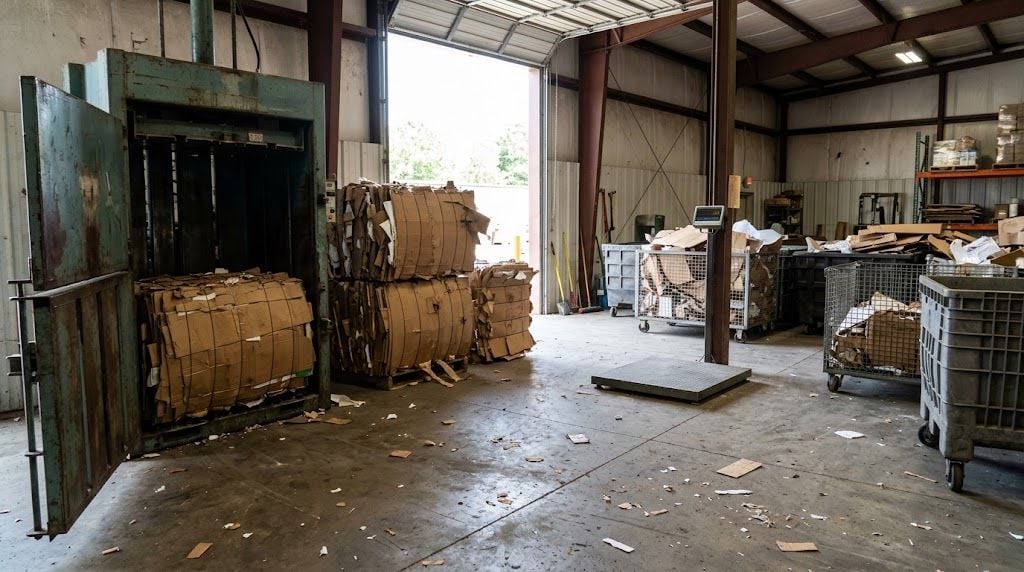
Starting a small recycling business that collects and sorts recyclables from other businesses takes roughly $58,500 to $228,000 under the planning assumptions in the table below. The core setup is a collection truck, containers for your customers, a baler, a way to move bales, and a warehouse to sort and store material until it ships. The business earns money two ways: service fees for collecting material and commodity sales when baled material goes to a mill or broker. Build the plan on the first, because the second moves with markets you don’t control.
Delta Capital Group’s current minimums are 6 months in business, $15,000 in monthly revenue, and a 500 credit score, so Delta’s products are aimed at recycling companies that are already operating rather than pre-revenue launches.
What a Commercial Recycling Business Does
A commercial recycling business collects recyclable material, such as cardboard, mixed paper, plastic film, and metals, from warehouses, offices, stores, and other businesses. It sorts and bales that material, then sells it by the ton to mills, processors, or brokers. Customers pay for regular pickups, and the business keeps the value of what it collects.
Startup Costs for a Recycling Business
| Cost item | Planning range used in this breakdown |
| Collection truck (used box truck with liftgate, or a used rear-loader) | $25,000 to $90,000 |
| Customer containers, carts and bulk boxes | $3,000 to $15,000 |
| Baler, vertical to start | $8,000 to $30,000 |
| Used forklift or pallet jacks | $3,000 to $25,000 |
| Floor scale | $1,500 to $5,000 |
| Warehouse deposit and first month’s rent | $5,000 to $25,000 |
| Permits, registration and insurance down payments | $2,500 to $10,000 |
| Website, routing software and sales materials | $500 to $3,000 |
| Operating reserve for payroll, fuel and freight | $10,000 to $25,000 |
| Total | $58,500 to $228,000 |
These figures are planning assumptions, not quotes. A rear-loader is often heavy enough to require a driver with a commercial driver’s license, while many box trucks are not. A vertical baler suits a new operation with modest volume, while a horizontal baler, which costs far more, becomes worth it as tonnage grows.
- 6+ months in business
- $15,000+ monthly revenue
- Active business bank account
Choosing What to Collect
Cardboard is where many commercial recyclers start, because nearly every business generates it, it bales well, and it has established buyers. Metals can carry higher value per ton but need separate handling, and plastics vary widely in what buyers will take. Buyers for recovered fiber are well established: a 2026 economic impact study from the Recycled Materials Association reports that more than 75 percent of U.S. paper mills use recycled paper to make new products. The same study puts direct employment at recycling businesses at about 175,000.
Start with one or two materials you can sell reliably in your region. Before signing customers, call the mills, processors, and brokers within trucking distance and ask what they buy, in what form, at what bale weight, and on what payment terms.
Permits and Registration
Requirements depend on the state and on what you do with the material. Many states require registration or a permit for facilities that handle or process recyclables, and some exempt operations that only handle source-separated material. Your city or county will also apply zoning rules to an outdoor storage or processing yard. Recycling facilities, including those that only handle source-separated recyclables, can also need industrial stormwater permit coverage, particularly where material is stored or handled outdoors.
Call your state environmental agency before signing a warehouse lease. A permit question is far cheaper to answer before you commit to a building than after.
| Feature | Unsecured | Secured |
|---|---|---|
| Collateral | None | Required |
| Approval Speed | 24-48 hrs | 2-4 weeks |
| Credit Score | 500+ | 650+ |
The Route Math, and Why Service Fees Matter
Imagine a recycler collecting cardboard from 25 businesses, about 40 tons a month in total. Each account pays a $75 monthly service fee, or $1,875 a month. If the baled cardboard sells for $90 a ton, commodity revenue adds $3,600, for a total of $5,475 a month before the driver, fuel, baling wire, freight to the mill, and the truck payment.
Now suppose the market price drops to $40 a ton. Commodity revenue falls to $1,600, and the month’s total falls to $3,475. The service fees stayed at $1,875. Recyclers who depend only on commodity prices tend to struggle in down markets, which is why pricing every account so the pickup pays for itself is the safer plan. Before settling on a fee like $75, work out the pickup frequency, drive time, labor, and container costs for that account.
Working Capital Between Pickup and Payment
Mills and brokers may pay 30 days or more after a load ships, while drivers, fuel, and rent are paid weekly or monthly. As tonnage grows, so does the cash tied up in material on the floor and in transit. Our guide to how much working capital you need walks through how to size that buffer.
Delta Capital Group Funds Recycling Businesses Nationwide
If your recycling company has been operating for at least six months and you’re adding a baler, a truck, or a forklift, Delta Capital Group provides equipment financing and working capital to business owners across the country. Equipment financing is structured around the equipment’s useful life. No collateral is required beyond the equipment for most equipment financing. Approvals happen in as little as 24 hours, and 95 percent of approved applicants are funded within 48 hours. Minimum qualifications are 6 months in business, $15,000 in monthly revenue, and a 500 credit score. Apply at deltacapitalgroup.com.
Frequently Asked Questions
How do recycling businesses make money?
Through service fees for collecting material and through selling sorted, baled material to mills, processors, or brokers. Service fees are the steadier part. Commodity prices can swing widely, so a plan that only works at high prices is fragile.
Do you need a permit to start a recycling business?
Often, yes. Many states require registration or a permit for facilities that handle or process recyclables, and local zoning applies to the building or yard. Requirements vary by state and by material, so check with your state environmental agency first.
What equipment does a recycling business need?
A collection truck, customer containers, a baler, a forklift or pallet jacks, a floor scale, and covered space to sort and store material. Larger operations add horizontal balers, conveyors, and more trucks.
Which materials should a new recycling business start with?
Usually cardboard, because it’s widely generated, simple to bale, and sold through established channels. Add metals or specific plastics once you’ve confirmed nearby buyers and the handling they require.
Can I finance a baler or a collection truck?
Yes. Balers, trucks, and forklifts are commonly financed as equipment. Delta publishes minimums of 6 months in business, $15,000 in monthly revenue, and a 500 credit score, subject to underwriting, so the fit is an operating company adding capacity.
What owners say about us
Huge thank you to Ruben Davis and Delta Capital Group! Ruben stepped in, helped me navigate everything, and secured the funds I needed right on time. Quick turnaround, clear communication, and completely reliable. If you need working capital without…
 David Goldman2 weeks ago on Google
One of the most honest trusted and appreciated company I know so far. They took the time and vision to help a situation. And form great relationships with their clients. Thanks for always being there for my business
 Buffet Kreyol2 weeks ago on Google
It has been a pleasure working with Dov as my lender. He is knowledgeable, trustworthy, and always willing to help. I have worked with him for almost two years, and his professionalism and commitment to excellent service have been outstanding. I high…
 Alejandro Chavez5 months ago on Google

Allen White is a Managing Partner at Delta Capital Group with more than 30 years in financial services. He started his career on Wall Street and left it to work directly with small business owners, and he still talks with owners himself about what kind of funding makes sense for them. More about Allen