
Starting a dumpster rental business takes roughly $115,500 to $407,000 under the planning assumptions in the table below. A roll-off truck and a starter fleet of containers make up most of that. The model is straightforward: you drop an open-top container at a customer’s site, the customer fills it, and you haul it to a landfill or transfer station, pay the tipping fee by the ton, and bill a flat rental that includes a weight allowance. Profit depends on a rental price that covers disposal, delivery and pickup, fuel, driver time, equipment and overhead, with per-ton overage charges protecting you when customers load heavy.
Delta Capital Group’s current minimums are 6 months in business, $15,000 in monthly revenue, and a 500 credit score, so Delta’s products are aimed at roll-off companies that are already operating rather than pre-revenue launches. The natural point for funding is the second truck or the next batch of containers.
What a Roll-Off Dumpster Business Is
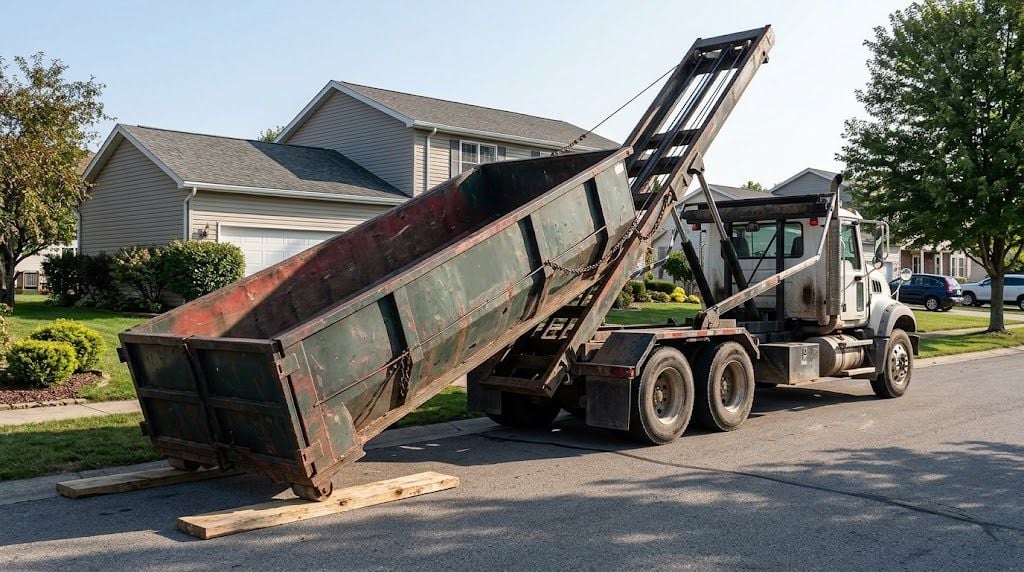
A roll-off dumpster business rents open-top steel containers, commonly sized at 10, 15, 20, 30, and 40 cubic yards, that a truck with a hoist rolls on and off at the customer’s site. Each rental is usually a flat price for a set number of days, including delivery, pickup, and a tonnage allowance, with overage charged per ton.
Startup Costs for a Dumpster Rental Business
| Cost item | Planning range used in this breakdown |
| Roll-off truck with hoist, used to new | $60,000 to $220,000 |
| 12 to 20 containers in mixed sizes | $36,000 to $120,000 |
| Registration, hauler permits and licenses | $500 to $3,000 |
| Insurance down payments (commercial auto, general liability) | $4,000 to $12,000 |
| Yard deposit and setup | $2,000 to $10,000 |
| Website, booking and dispatch software | $1,000 to $4,000 |
| Launch marketing | $2,000 to $8,000 |
| Operating reserve for fuel, tipping fees and payroll | $10,000 to $30,000 |
| Total | $115,500 to $407,000 |
These are planning assumptions, not quotes. The truck sets the range. Used roll-off trucks are common, and many come through equipment auctions. Arrange financing before you bid, because auction payment deadlines can be shorter than a lender’s approval process. Our guide to financing equipment bought at auction explains how preapproval works.
Choosing Containers and the Truck
The 20-yard container is the workhorse for many new fleets because it suits cleanouts, roofing jobs, and small remodels. A few 10-yard boxes handle heavy material such as concrete, dirt, and brick, which reaches weight limits long before it fills the space, and 30- and 40-yard boxes serve commercial and large demolition jobs.
Most full-size roll-off trucks are rated well above 26,001 pounds, the general threshold at which a single vehicle requires a commercial driver’s license, so plan on a CDL holder behind the wheel. Check federal and state registration rules for the truck as well.
Tipping Fees Set Your Prices
Disposal is the cost that moves with every haul, so price from it backward. The Environmental Research & Education Foundation’s 2024 analysis of landfill tipping fees, as reported by Waste Advantage Magazine, put the national average at $62.28 a ton after a 10 percent increase, with large landfills charging over $70. Construction and demolition debris, which fills many roll-off containers, may be priced separately from household trash, so get both local rates and prices from those.
Take a single haul. Imagine an owner who rents a 20-yard container for $475 for seven days, including 2 tons, with overage at $85 a ton. The customer loads 2.6 tons, so the bill comes to $526. At the transfer station, the owner pays $60 a ton, or $156. Driver time for delivery, pickup, and the dump run comes to three hours at $28 an hour, or $84, and fuel is about $60. That leaves roughly $226 before the truck payment, container wear, insurance, and overhead.
The same rental priced with no overage charge would leave about $175. Overage pricing, prohibited-item fees, and clear fill lines are what protect the margin when customers load heavy.
Permits and Rules to Check
Register the business, then check local hauler licensing, since many cities and counties license or franchise waste hauling. Placement matters too: many municipalities require a permit for a container that sits on a public street, while driveway placements usually don’t need one. Landfills and transfer stations publish lists of prohibited items, commonly including tires, batteries, liquids, and hazardous materials, and your rental agreement should mirror them.
Cash Flow Between the Scale and the Invoice
Tipping fees are often paid at the scale or billed by the landfill monthly, while contractor customers may pay on 30-day terms. That timing gap grows as the fleet grows. A business line of credit is one way to cover disposal and fuel during the weeks between the dump run and the customer’s payment.
Delta Capital Group Funds Dumpster Rental Companies Nationwide
If your roll-off business has been operating for at least six months and you’re adding containers or a second truck, Delta Capital Group provides equipment financing and working capital to business owners across the country. Equipment financing is structured around the equipment’s useful life. No collateral is required beyond the equipment for most equipment financing. Approvals happen in as little as 24 hours, and 95 percent of approved applicants are funded within 48 hours. Minimum qualifications are 6 months in business, $15,000 in monthly revenue, and a 500 credit score. Apply at deltacapitalgroup.com.
“Got funded in under 24 hours. The process was straightforward and my rep walked me through everything.”
Frequently Asked Questions
How many dumpsters do you need to start a rental business?
Many owners start with somewhere around a dozen to twenty containers for one truck, weighted toward 20-yard boxes. Too few and the truck sits idle waiting for returns. Too many and capital sits in the yard. Size the fleet to the jobs you can book.
Do you need a CDL to drive a roll-off truck?
Usually. Most full-size roll-off trucks are rated well above 26,001 pounds, and a single vehicle at or above that rating generally requires a commercial driver’s license. Some lighter trucks built for smaller containers fall below it, so check the rating on the specific truck.
How do dumpster rental companies charge for weight?
Many include a tonnage allowance in the flat rental price and charge a per-ton overage above it, based on the landfill or transfer station scale ticket. Some charge extra for heavy material such as concrete or dirt, or require it in a separate container.
What size dumpster should a new rental business buy first?
The 20-yard container covers the widest range of residential and small commercial jobs, so it usually makes up the core of a starter fleet. Smaller boxes suit heavy debris, and larger ones suit commercial and demolition work.
Can I finance a roll-off truck and containers?
Yes. Roll-off trucks and containers are commonly financed as equipment. Delta publishes minimums of 6 months in business, $15,000 in monthly revenue, and a 500 credit score, subject to underwriting, so the fit is an operating company expanding its fleet.
