
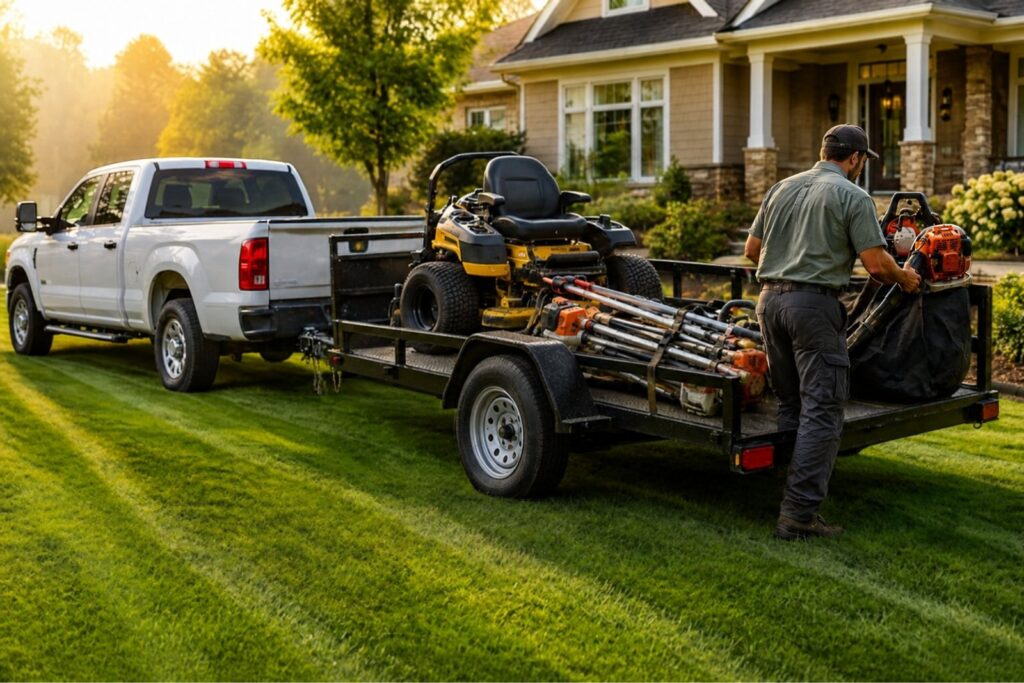
A one-person lawn care business can start for $5,000 to $10,000 if you already own a pickup, according to Joist’s guide to starting a landscaping business. Once you add a work truck, a trailer and commercial equipment for a crew, most new landscaping companies spend somewhere between $15,000 and $85,000.
Where you land in that range comes down to three choices: whether you buy or already own a truck, whether you buy new or used equipment, and whether you start solo or with a crew.
Truck and Trailer
The truck is usually the biggest expense. ZenBusiness puts a work truck at $10,000 to $75,000 or more, new or used, and a small equipment trailer at $1,000 to $6,000, in its breakdown of lawn service startup costs.
If you already drive a full-size pickup that can tow, start with it. Plenty of successful landscaping companies ran their first season out of the owner’s personal truck and bought a dedicated work truck once the route was full.
Mowers and Equipment
For a small residential route, ZenBusiness estimates the equipment list alone at about $12,000 to $85,000 or more depending on how much you buy and whether it’s new. A starter setup looks something like this:
- Mowers: a medium-grade gas push mower runs $500 to $1,000, and you’ll want at least two. Commercial zero-turn and stand-on mowers cost many times that, but they cut the time per yard dramatically.
- String trimmer: $100 to $500
- Edger: $100 to $600
- Leaf blower: $100 to $500
- Hedge trimmer: $100 to $400
- Spreader and sprayer: $150 to $1,100 combined
- Hand tools, gas cans and safety gear: a few hundred to over $1,000
Buying commercial-grade gear costs more up front, but it holds up to daily use. Residential equipment wears out fast on a full route. Many owners spread the cost with equipment financing instead of draining their cash before the season starts.
“Got funded in under 24 hours. The process was straightforward and my rep walked me through everything.”
Insurance, Licenses and Permits
Most lawn care businesses pay about $500 to $2,000 a year for insurance, according to ZenBusiness. Joist cites a median of about $45 a month for general liability alone. If you use a truck for the business, you’ll also need commercial auto coverage, and workers’ comp kicks in once you hire.
Licensing depends on your state and what work you do. Mowing and cleanup usually need just a business license. Applying fertilizer or weed control often requires a pesticide applicator license, and hardscaping or irrigation work can require a contractor license. Aspire estimates licensing, permits and insurance together at $300 to $3,500 in its landscaping startup cost guide.
Marketing and Software
Landscaping is a local business, and most new companies win their first customers through yard signs, door hangers, a Google Business Profile and word of mouth. Aspire puts marketing at $500 to $1,000 if you do it yourself and $1,000 to $5,000 if you hire it out.
Scheduling and invoicing software runs $25 a month to $1,000 or more a year depending on the platform and crew size. It’s worth it early, because missed visits and late invoices cost more than the subscription.
Payroll and Working Capital
If you start with a crew, payroll is the cost to plan for. ZenBusiness gives the example of two workers at $16 an hour: that’s $640 each per week, or more than $5,000 in wages over four weeks before you’ve collected from a single commercial client. Commercial and HOA accounts often pay on 30-day terms or longer.
Landscaping is also seasonal in most of the country. You’ll earn most of your revenue in spring and summer and still have truck payments and insurance in the winter. Our guide to managing cash flow in a seasonal business covers how to plan for the slow months.
Sample Startup Budgets
- Solo, using your own pickup and basic equipment: $5,000 to $10,000
- Solo with a work truck and trailer: $15,000 to $40,000
- Small crew with commercial mowers and a dedicated truck: $40,000 to $85,000 or more
Aspire reports that new landscaping businesses average about a 15 percent profit margin, which tends to improve as routes get denser and crews get faster.
Financing Options for Landscaping Companies
- Equipment financing for mowers, trucks and trailers
- A business line of credit for payroll and fuel during the busy season
- Short-term loans to cover winter months or a large commercial contract
- Invoice factoring to get paid now on commercial accounts with long payment terms
Funding for Landscaping Companies from Delta Capital Group
Delta Capital Group is a direct funder, not a broker. We provide working capital from $5,000 to $5,000,000 to landscaping and lawn care companies across the country, whether you’re buying a new zero-turn, adding a second crew or getting through the winter. Approvals happen in as little as 24 hours, and 95 percent of approved applicants are funded within 48 hours. To qualify, you need at least 6 months in business, $15,000 in monthly revenue and a 500 credit score.
See how we work with contractors and service businesses, or apply now and talk to a funding advisor today.
Frequently Asked Questions
Can I start a lawn care business with $5,000?
Yes, if you already own a truck that can tow. $5,000 covers a couple of mowers, trimmers, a blower, basic insurance and some marketing. You’ll be doing residential mowing to start, and you can add equipment as your route grows.
Do I need a license to start a landscaping business?
You’ll need a general business license almost everywhere. If you apply fertilizer, herbicides or pesticides, most states require a pesticide applicator license. Some states also require a contractor license for hardscaping, irrigation or jobs over a certain dollar amount.
Should I buy new or used landscaping equipment?
Used commercial equipment from a reputable dealer is often a better deal than new residential equipment. It’s built for daily use. Check the hours, maintenance records and parts availability before you buy.
How much does a landscaping business make?
It varies widely by market and services. Aspire reports average margins of about 15 percent for new landscaping businesses, growing as the company matures. Adding higher-margin services like fertilization, irrigation or hardscaping is the usual path to better profits.
How do landscaping companies survive the winter?
Most plan for it: they set aside cash from the busy season, add snow removal or holiday lighting, sell prepaid annual contracts, or use a line of credit to cover fixed costs until spring.
What owners say about us
Huge thank you to Ruben Davis and Delta Capital Group! Ruben stepped in, helped me navigate everything, and secured the funds I needed right on time. Quick turnaround, clear communication, and completely reliable. If you need working capital without…
 David Goldman2 weeks ago on Google
One of the most honest trusted and appreciated company I know so far. They took the time and vision to help a situation. And form great relationships with their clients. Thanks for always being there for my business
 Buffet Kreyol2 weeks ago on Google
It has been a pleasure working with Dov as my lender. He is knowledgeable, trustworthy, and always willing to help. I have worked with him for almost two years, and his professionalism and commitment to excellent service have been outstanding. I high…
 Alejandro Chavez5 months ago on Google

Allen White is a Managing Partner at Delta Capital Group with more than 30 years in financial services. He started his career on Wall Street and left it to work directly with small business owners, and he still talks with owners himself about what kind of funding makes sense for them. More about Allen