
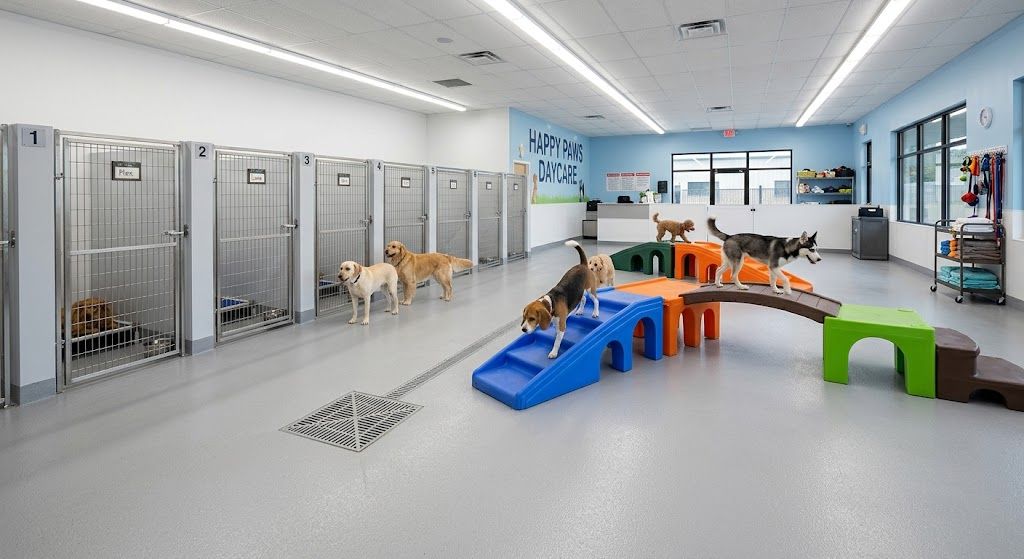
Starting a dog daycare typically costs between $110,000 and $400,000 all in, with most owners landing near $180,000 for a leased facility of 3,000 to 5,000 square feet. Roughly $30,000 to $80,000 of that is working capital held in reserve rather than spent on the build, so the pure build-and-open figure is usually closer to $80,000 to $320,000. The largest single variable is build-out. Converting a warehouse or retail unit into a compliant boarding and play space usually costs more than the lease itself in year one, because flooring, drainage, ventilation, and fencing all have to meet standards that ordinary commercial space does not.
A dog daycare provides supervised group or individual care for dogs during the day, usually charging $25 to $50 per dog per day, with packages and add-on services such as grooming, training, and overnight boarding layered on top. Revenue scales with capacity and staff ratios rather than with foot traffic, which makes square footage and licensing limits the binding constraints on how much a location can earn.
Where the money goes
Build-out dominates the budget. Sealed and slip resistant flooring runs $8 to $20 per square foot installed, and cutting this line is a false economy. Unsealed concrete can absorb odors and may not meet local sanitation requirements, so commercial facilities commonly use sealed or coated flooring. Floor drains and a wash-down system add $10,000 to $40,000. Ventilation sized for animal occupancy, which is materially higher than for people, costs $15,000 to $50,000. Interior fencing, gates, and kennel panels add $15,000 to $60,000 depending on capacity.
Lease costs follow. A 4,000 square foot unit in a light industrial zone commonly runs $4,000 to $10,000 a month, and landlords frequently want first month, last month, and a deposit before build-out even begins. Zoning is the hidden gate here. Many municipalities restrict animal boarding to specific zones, and some require a conditional use permit with a public hearing, which can add two to six months before any revenue arrives.
Equipment is comparatively modest: kennels and crates at $5,000 to $25,000, play structures and pools at $2,000 to $10,000, washer and dryer units rated for commercial volume at $4,000 to $12,000, and a booking and camera system at $2,000 to $8,000.
Insurance is where owners are most often caught out. Animal care operations need general liability plus an animal bailee policy, which covers dogs in your custody. Expect $3,000 to $12,000 in year one, and expect the carrier to ask detailed questions about staff ratios and separation protocols.
| Cost area | Typical range |
| Lease deposit and first rent | $12,000 to $30,000 |
| Build-out including flooring and drainage | $40,000 to $180,000 |
| Fencing, kennels, and play equipment | $22,000 to $95,000 |
| Insurance, year one | $3,000 to $12,000 |
| Licensing, permits, and legal | $2,000 to $10,000 |
| Working capital before break-even | $30,000 to $80,000 |
Staffing is the real operating constraint
Industry guidance commonly recommends roughly one handler per 10 to 15 dogs in group play, though there is no single national legal standard and requirements vary by state, municipality and insurer. Whatever ratio applies to you, it rather than floor space usually caps revenue. A facility physically able to hold 60 dogs cannot run at 60 unless it can staff and retain four to six handlers on the floor.
Handler wages of $15 to $22 an hour mean payroll often consumes roughly 35 to 50 percent of revenue and can approach 55 percent in labor-heavy operations, which is high for a service business. Turnover compounds it, since the work is physically demanding and a new handler needs weeks of supervision before working independently.
That payroll weight is why dog daycares run into cash flow trouble at a specific and predictable moment: the ramp between opening and full enrollment. Imagine a facility that opens in March, staffs for 45 dogs because that is what the schedule will eventually require, and averages 18 dogs a day until August. Payroll is at target from week one while revenue arrives on a five month delay.
Need Funds Quickly?
Why the market is fragmented and what that means
The U.S. pet grooming and boarding sector reached $15.4 billion across 193,181 businesses in 2026, with business formation growing at a 7.6 percent compound annual rate since 2021 and the average operator employing just 1.9 people. That combination, rapid formation and tiny average operator size, describes a market filling up with small independents rather than consolidating under a few brands.
For a new facility, the practical read is that competition is local and beatable, but differentiation has to be operational. Capacity, hours, camera access for owners, and reliability of staffing tend to matter more to customers than pricing, because a dog owner switching providers is making a trust decision rather than a cost decision.
Funding a Dog Daycare Once It Is Open
Delta Capital Group funds operating facilities rather than pre-revenue startups. Minimum qualifications are 6 months in business, $15,000 in monthly revenue, and a 500 credit score, so the products below apply to a daycare that is already trading and wants to add capacity, expand into boarding, or replace equipment.
Delta Capital Group provides unsecured working capital from $5,000 to $5,000,000 to business owners across the country. No collateral required beyond the equipment for most equipment financing. Approvals happen in as little as 24 hours, and 95 percent of approved applicants are funded within 48 hours. Apply at deltacapitalgroup.com.
Owners financing kennels, wash systems, or play structures often use equipment financing, while those covering payroll through a seasonal dip typically look at a short-term loan or a business line of credit. The $5,000 to $5,000,000 range describes Delta’s overall funding, not the limit on any single product.
Ready to get started?
Frequently asked questions
How much does it cost to start a dog daycare? Most owners spend $110,000 to $400,000 all in, with around $180,000 typical for a leased facility of 3,000 to 5,000 square feet. Build-out, not rent or equipment, is usually the largest line.
Is a dog daycare profitable? It can be, though margins depend heavily on utilization. Payroll often runs 35 to 50 percent of revenue and can approach 55 percent in labor-heavy operations, so facilities well below capacity struggle even with strong daily rates.
How long does it take to reach full enrollment? Four to twelve months is common. Enrollment builds through referral and trial days rather than advertising, which means revenue ramps more slowly than staffing costs.
Do I need a special license to run a dog daycare? Requirements vary widely. Many areas require an animal care or kennel license, and zoning approval for animal boarding is often a separate and slower process. Confirm both before signing a lease.
Can I get funding for a dog daycare with bad credit? Revenue-based products weigh recent deposit history more heavily than credit score. Delta’s stated minimum is a 500 FICO alongside 6 months in business and $15,000 in monthly revenue, subject to underwriting.

