
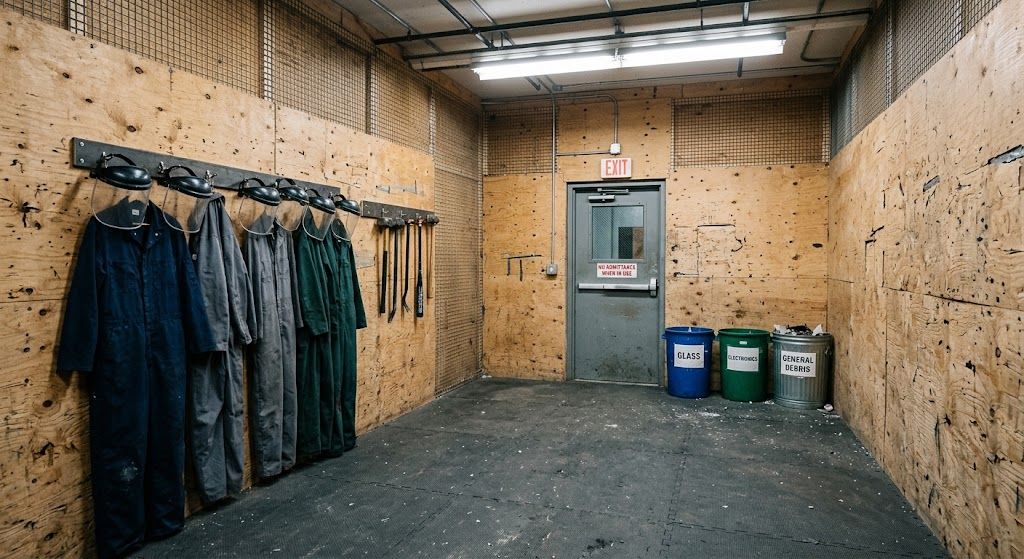
Opening a rage room typically costs between $38,000 and $130,000, with most independent operators landing near $70,000 for a two- or three-room site in leased industrial space. That is unusually low for a recreation venue, because the core product needs almost no manufactured equipment. The cost sits in reinforcing the rooms, protecting participants, insuring the operation, and solving a problem most operators underestimate: what to do with several tons of broken material every month.
A rage room is a venue where customers pay to destroy household objects in a controlled space, wearing protective gear, usually in sessions of 15 to 45 minutes priced between $30 and $160 depending on group size and what is included in the package. Revenue concentrates heavily in evenings, weekends, group bookings, and corporate events.
Where the money goes
Room construction is the largest line. Each room needs reinforced walls, usually plywood or rubber sheeting over the existing surface, a durable floor, protected lighting, and a camera, at $5,000 to $15,000 per room. Two or three rooms is the common starting configuration, since a single room caps throughput at roughly one group per hour.
Lease costs come next. Rage rooms suit light industrial units where noise is not a problem and rent is cheap, commonly $1,500 to $4,500 a month for 2,000 to 4,000 square feet.
Safety equipment is cheap and not optional. Coveralls, full-face shields, cut-resistant gloves, chest protectors and closed footwear run $150 to $400 per participant set, and you need enough to cover your largest simultaneous booking plus turnover for cleaning. Budget $4,000 to $12,000.
Insurance separates viable operators from stalled ones. General liability for a venue built around controlled destruction is a specialty placement, priced on room construction, supervision, waiver practice and protective gear protocol. Expect $6,000 to $20,000 in year one, and expect to supply photographs of your rooms before a quote is issued.
| Cost area | Typical range |
| Room build-out, 2 to 3 rooms | $10,000 to $45,000 |
| Lease deposit and first rent | $4,500 to $13,500 |
| Safety gear and replacements | $4,000 to $12,000 |
| Insurance, year one | $6,000 to $20,000 |
| Booking system, cameras, signage | $3,000 to $9,000 |
| Working capital before break-even | $10,000 to $30,000 |
The two costs nobody budgets for
Breakables sourcing is the first. Most operators acquire glassware, electronics, and furniture free or nearly free from thrift stores, estate clearances, appliance retailers, and recyclers glad to divert the volume. The cost sits in collection, transport, and storage rather than purchase price, and a busy site consumes more inventory than owners project.
Waste disposal is the second, and it is the one that catches people. Everything a customer destroys leaves as waste, sorted by material. Glass, metal, and electronics generally require separate streams, and about half of US states plus the District of Columbia have electronics recycling laws, with requirements varying by product type and by whether you count as a generator. A commercial waste contract for this profile commonly costs $400 to $1,500 a month. Imagine a venue running 80 sessions a month, each generating two or three bins of mixed debris, against a disposal contract priced for a light office tenant. That gap surfaces in month two.
Throughput is the ceiling on revenue
Rage rooms look like a high-margin business, and unit economics are strong once rooms are built, because material cost per session can be low relative to ticket price when breakables are sourced cheaply. Breakables collection, gear replacement, cleanup labour, and disposal are still real variable costs. The harder constraint is time.
Each session needs a cleanout between bookings, generally 10 to 20 minutes, plus a briefing and gear fitting before. Realistic capacity is one to two groups per room per hour at peak, and peak is narrow: Friday evening, Saturday and Sunday afternoon carry most of the week’s revenue. Corporate events and birthday packages fill the weekday gap, and operators who build that channel early outperform those relying on walk-ins.
The wider category gives some context for the model. The U.S. arcade, food and entertainment complex sector generates roughly $6 billion across more than 6,000 businesses, and rage rooms sit at its small experiential end alongside escape rooms and axe-throwing venues. Comparable format economics are covered in our breakdown of escape room startup costs and in our look at whether batting cages are profitable.
Ready to get started?
Franchise or independent
Rage room franchises exist, and franchise disclosure documents publish the actual investment ranges, which vary by brand and market. If you are weighing one, read the FDD rather than relying on a headline figure, and check specifically what the franchisor provides on insurance, since insurance placement can be one of the harder parts of opening this format and support differs between systems.
Independent operators keep the margin and the flexibility, and given how low the build cost is relative to other entertainment formats, many open independently.
Funding a Rage Room Once It Is Trading
Delta Capital Group funds operating venues rather than pre-revenue startups. Minimum qualifications are 6 months in business, $15,000 in monthly revenue, and a 500 credit score, so the products below apply once the venue is open and earning, typically to add rooms, expand capacity, or smooth the weekday trough.
Delta Capital Group provides unsecured working capital from $5,000 to $5,000,000 to business owners across the country. No collateral required beyond the equipment for most equipment financing. Approvals happen in as little as 24 hours, and 95 percent of approved applicants are funded within 48 hours. Apply at deltacapitalgroup.com.
Durable assets, such as building out an additional room or buying equipment with a useful life, may suit equipment financing. Protective gear, replacement consumables, breakables collection, cleaning labour and disposal are operating costs and sit better against working capital. The $5,000 to $5,000,000 range describes Delta’s overall funding, not the limit on any single product.
💡 Pro Tip
The smartest funding decisions come from understanding the full cost, not just the monthly amount. Visit our guides for more exclusive tips.
Frequently asked questions
How much does it cost to open a rage room? Most independent operators spend $38,000 to $130,000, with around $70,000 typical for a two or three room site in leased industrial space. Room build-out and insurance are the two largest lines.
Are rage rooms profitable? They can be, because material cost per session can be low relative to the ticket price once rooms are built. Profitability depends on filling weekday capacity through corporate and group bookings rather than relying on weekend walk-ins, and on controlling breakables collection, gear replacement and disposal.
Where do rage rooms get the items customers break? Mostly free or low cost from thrift stores, estate clearances, appliance retailers, and recyclers. The real cost is collection, transport, and storage rather than purchase.
What insurance does a rage room need? General liability written for a controlled destruction venue, priced on room construction, supervision ratios, waiver practice, and protective equipment. Carriers commonly request photographs of the rooms before quoting.
How long does it take to open a rage room? Three to six months is typical, with insurance placement and landlord approval usually taking longer than the build itself.

