
How to Start a Junk Removal Business: Costs, Trucks and Pricing
Starting a junk removal business takes roughly $31,300 to $121,500 under the planning assumptions in the table below, and the truck accounts for most of that spread. A used pickup with a dump trailer keeps the launch near the low end. A late-model junk truck with a dump body, a full wrap, and a paid helper push it toward the top. Profit comes from pricing by volume and keeping disposal costs down.
Delta Capital Group’s current minimums are 6 months in business, $15,000 in monthly revenue, and a 500 credit score, so Delta’s products are aimed at junk removal companies that are already operating, such as an owner adding a second truck, rather than pre-revenue launches. If you’re still at the idea stage, our guide to getting a business loan with no revenue yet covers the options.
What a Junk Removal Business Does
A junk removal business hauls unwanted items out of homes, offices, rental units, and job sites, then handles the disposal. The customer pays one price that covers labor, hauling, and dumping, usually quoted by how much of the truck the load fills.
Startup Costs for a Junk Removal Business
| Cost item | Planning range used in this breakdown |
| Truck, or a pickup and dump trailer | $20,000 to $80,000 |
| Registration, local permits and any hauler license | $300 to $1,500 |
| Insurance down payments (liability, commercial auto, workers’ comp) | $2,000 to $6,000 |
| Dollies, straps, tarps, hand tools and safety gear | $1,000 to $3,000 |
| Door signage or a full truck wrap | $500 to $5,000 |
| Website, booking software and phone line | $500 to $3,000 |
| Launch marketing | $2,000 to $8,000 |
| Operating reserve for fuel, dump fees and payroll | $5,000 to $15,000 |
| Total | $31,300 to $121,500 |
These are planning figures, not quotes. Truck prices vary by region, mileage, and body type.
Choosing the Truck
The truck sets your capacity, your price per load, and part of your licensing picture.
A pickup with a dump trailer is the cheaper start. A 7-by-14-foot trailer with 4-foot sides holds about 14.5 cubic yards, and you can unhitch it to run estimates or single-item pickups in the truck alone. The trade-offs are tight driveways and slower loading.
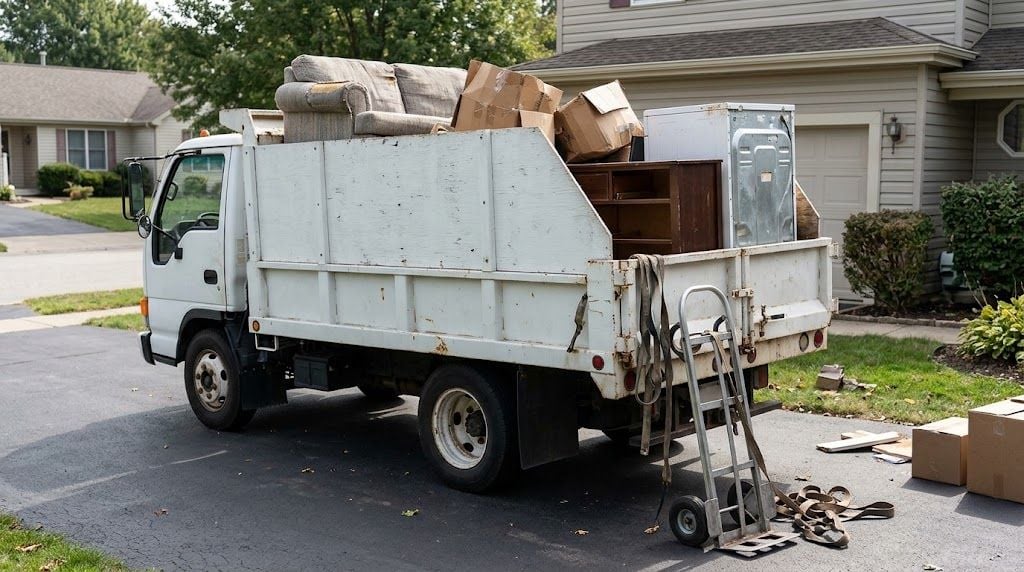
A purpose-built junk truck, usually a cab-over chassis with a high-sided dump body, loads faster, looks more established, and dumps without hand unloading. Capacity depends on the body, often around 12 to 20 cubic yards. It costs more, and its weight rating matters. In general, a single vehicle rated at 26,001 pounds or more requires a commercial driver’s license, and so can a combination rated at 26,001 pounds or more when the trailer is rated over 10,000 pounds. That’s one reason many operators stay below those lines, including with a pickup and a heavy dump trailer. Check your state’s rules before you buy.
Used trucks are common in this trade and can be financed. Our guide to equipment financing for used equipment explains how age and mileage can affect the terms.
| Feature | Unsecured | Secured |
|---|---|---|
| Collateral | None | Required |
| Approval Speed | 24-48 hrs | 2-4 weeks |
| Credit Score | 500+ | 650+ |
How to Price Junk Removal Jobs
Many operators price by volume, as a fraction of the truck: a minimum charge for a single item, then eighths, quarters, halves, and a full load. Many add surcharges for heavy material such as concrete, dirt or shingles, which can hit a weight limit while the truck still looks half empty, and for items that cost more to dispose of, such as mattresses, tires and appliances that contain refrigerant.
Imagine an owner running a 15-yard truck who charges $375 for a half load. Disposal on a typical half load of household items comes to about $50 at her transfer station’s rates, two crew members spend 1.5 hours each on the job at $22 an hour, and fuel for the round trip is about $25. That leaves roughly $234 before insurance, marketing, the truck payment, and the owner’s own pay. According to the Bureau of Labor Statistics, the national median pay for hand laborers and material movers was $18.38 an hour in May 2025, so the $22 used here assumes a premium for crews who also deal directly with customers.
Two habits protect that margin. Sort every load before dumping: furniture in good condition can go to a donation center, metal to a scrap yard, and cardboard to recycling, and each can cut what you pay at the scale, depending on what those outlets accept and the extra driving. And quote on site or from photos, because “a few things in the garage” rarely matches what you find.
Licensing, Insurance and Disposal Accounts
Register the business, then ask your city or county about hauler permits. Commercial auto and general liability are the core policies, and many states require workers’ compensation once you have employees, and some set a minimum headcount. Open accounts with your local transfer station or landfill before the first job and learn what it refuses. Hazardous materials such as paint, solvents, and asbestos generally need specialized handling outside a standard junk removal load.
Growing Past One Truck
Once one truck is booked out for full days, a second truck and crew can roughly double capacity. Recurring work from property managers, real estate professionals, estate cleanouts, and contractors helps smooth the seasonal swing, since residential demand often peaks with spring cleaning and summer moves. Equipment financing can spread the second truck’s cost across its years in service.
Delta Capital Group Funds Junk Removal Businesses Nationwide
If your junk removal company has been operating for at least six months and you’re ready to add a truck, a trailer or a crew, Delta Capital Group provides equipment financing and working capital to business owners across the country. Equipment financing is structured around the equipment’s useful life. No collateral required beyond the equipment for most equipment financing. Approvals happen in as little as 24 hours, and 95 percent of approved applicants are funded within 48 hours. Minimum qualifications are 6 months in business, $15,000 in monthly revenue, and a 500 credit score. Apply at deltacapitalgroup.com.
Frequently Asked Questions
Can you start a junk removal business with just a pickup truck?
Yes. A pickup with a dump trailer is a common starting setup, and some operators begin with the pickup bed alone for single items. Capacity is the limit: smaller loads mean more dump trips and less revenue per job.
Do you need a license to start a junk removal business?
You need a business registration. Beyond that, it depends on your city, county, and state: some require a waste hauler permit, and a heavier truck can bring commercial licensing requirements.
What can’t a junk removal company take?
Hazardous materials such as paint, solvents, asbestos, and medical waste are commonly excluded, along with anything your disposal site refuses. Tires, mattresses, and appliances that contain refrigerant are often accepted for a surcharge.
Can I finance a junk removal truck?
Yes. Trucks and trailers are commonly financed as equipment, with the vehicle securing the financing. Delta publishes minimums of 6 months in business, $15,000 in monthly revenue, and a 500 credit score, subject to underwriting, so the fit is an operating business adding capacity.

