
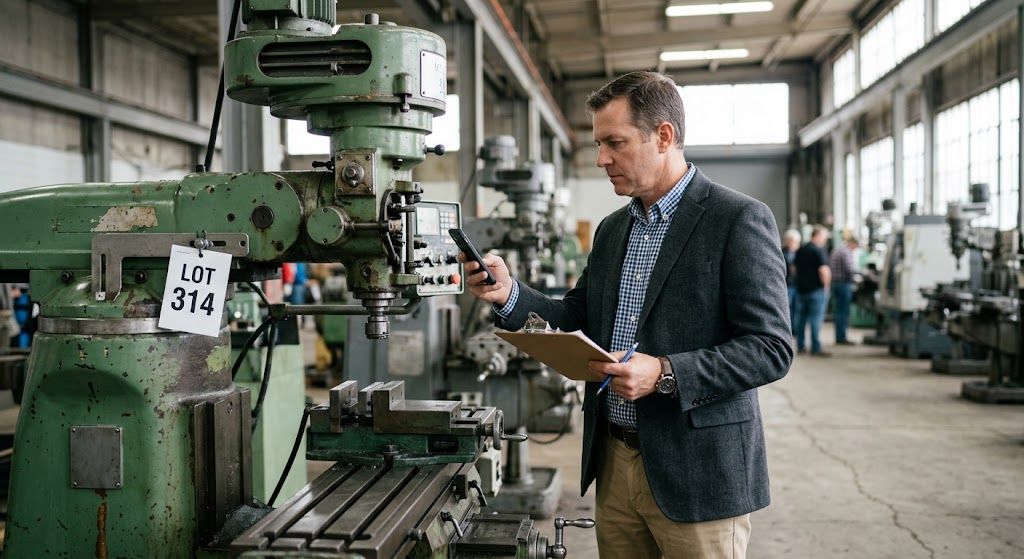
Yes, business equipment bought at auction can be financed, but the process runs in reverse compared with a normal purchase. Settlement terms vary by auction house, and many require payment within days of the hammer falling, which leaves little room to arrange funding afterwards. Because of that, preapproval with a stated ceiling before you bid is usually the safest approach rather than arranging finance once you have won the lot.
This applies to general business equipment: machine tools, commercial kitchen lines, printing and packaging equipment, woodworking machinery, fabrication gear, restaurant and laundry plant, and similar assets sold through liquidation, bankruptcy, and dealer auctions. Vehicle inventory purchased for resale works under a different structure entirely and is not what this covers.
Why lenders treat auction purchases differently
Three features of an auction make underwriting harder than a straightforward dealer purchase, and understanding them tells you what a funder will ask for.
Valuation is the first. In a normal purchase there is an invoice, a make and model, and a dealer standing behind the price. At auction, the price is whatever the room paid on the day, which may sit well below or occasionally above fair market value. A funder lending against an asset needs a defensible value, so it may cap its advance based on an independent or otherwise supportable valuation rather than on your winning bid.
Condition is the second. Auction lots are almost always sold as-is, where-is, with no warranty and frequently no functional test. A funder financing a machine that may or may not run carries a risk that a dealer warranty would otherwise absorb. This is why inspection documentation matters more here than anywhere else in equipment finance.
Speed is the third. The settlement window is short, and funders who do not work in this space regularly cannot move inside it. That is the practical reason to arrange the facility in advance rather than shopping for it after the sale.
What to have in place before you bid
The sequence that works looks like this.
Get a pre-approval with a stated ceiling, not a general indication. A funder who has reviewed your financials and issued a limit can release against a specific lot quickly, because the credit decision is already made and only the asset assessment remains.
Register with the auction house early and read the settlement terms. Buyer premiums are common in commercial equipment sales and are often excluded from the financed amount, so check the rate for that specific sale and plan to cover it from your own funds. Removal deadlines matter too: many sales require the lot to be cleared within days, and rigging and transport for heavy machinery can run into thousands.
Inspect, and document the inspection. Photographs, serial numbers, hour or cycle counts, and a note of any missing components turn an unverifiable lot into something a funder can assess. If the sale allows a preview day, use it.
Confirm what the funder will actually advance against. A funder may finance the hammer price and, in some cases, the buyer’s premium; treatment of transport, rigging, installation and refurbishment varies. On heavy machinery, those soft costs can add a substantial amount on top of the hammer price, and underestimating them is a common reason a purchase that looked affordable turns out not to be. Get quotes for rigging and transport before you bid.
| Cost element | Common treatment |
| Hammer price | Often eligible |
| Buyer premium | Varies by funder |
| Transport and rigging | Often separate |
| Installation and commissioning | Often separate |
| Refurbishment or missing parts | Usually excluded |
Where the value actually is
The reason owners keep returning to auctions is straightforward. Well-maintained used machinery can sell well below comparable dealer pricing, and liquidation sales from a closing business often include recently serviced equipment.
Set against that, the absence of warranty means an unexpected repair can erase the savings in one event. The businesses that do well buying at auction tend to be those with in-house maintenance capability or an established relationship with a service engineer, because they can assess condition accurately and fix what they buy.
Equipment financing itself remains active as a market. The Equipment Leasing and Finance Association reported $10.8 billion in new business volume in March 2026 and said the first quarter of 2026 was its strongest quarter on record. Availability is not the constraint on an auction purchase. Timing and documentation are.
Need Funds Quickly?
How this differs from a dealer or private seller purchase
Buying from a dealer gives you an invoice and a verifiable seller, and may include a warranty, though used equipment dealers also sell as-is. That verifiability tends to make dealer purchases easier to underwrite than an auction lot. Private seller purchases sit in between, and the specific requirements there are covered in our guide to equipment financing for used equipment.
Auctions can offer lower acquisition prices, but they also provide less protection and tighter timelines. They suit buyers who know the asset class well and have funding arranged before the catalogue is published.
Finance Your Equipment Purchase with Delta Capital Group
Delta Capital Group provides unsecured working capital from $5,000 to $5,000,000 to business owners across the country. That range describes Delta’s overall funding rather than the limit on any single product, and equipment financing carries its own limits. No collateral required beyond the equipment for most equipment financing. Approvals happen in as little as 24 hours, and 95 percent of approved applicants are funded within 48 hours. Minimum qualifications are 6 months in business, $15,000 in monthly revenue, and a 500 credit score. Apply at deltacapitalgroup.com.
Buyers who need certainty before bidding often arrange equipment financing in advance, and those covering rigging, transport, or installation alongside the purchase sometimes pair it with a short term loan, since soft costs are often excluded from an equipment facility.
✓ 6+ months in business
✓ $15,000+ monthly revenue
✓ Active business bank account
Frequently asked questions
Can you get equipment financing for an auction purchase? Yes. Because many auctions require rapid settlement, preapproval before you bid is usually the safest approach rather than arranging funding after you win. Settlement windows vary by auction house, so check the terms for the specific sale.
Will a lender finance the buyer premium? Sometimes. Buyer premiums are common on commercial equipment sales, and some funders include them while others treat them as your contribution. Check the premium rate for that sale and confirm the funder’s position before bidding.
What documentation do I need for auction equipment financing? The lot listing, serial number, photographs, any inspection notes, hour or cycle readings, and the auction house invoice once you win. Preview day documentation makes approval materially faster.
Does as-is condition affect approval? It can affect both approval and the advance rate. Lenders may require more documentation, apply a lower advance, ask for an inspection, or decline an asset whose condition cannot be verified.
Are transport and installation costs included? Usually not. Rigging, transport, installation, and refurbishment can add materially to the total on heavy machinery and generally need separate funding. Get quotes before you bid.

