
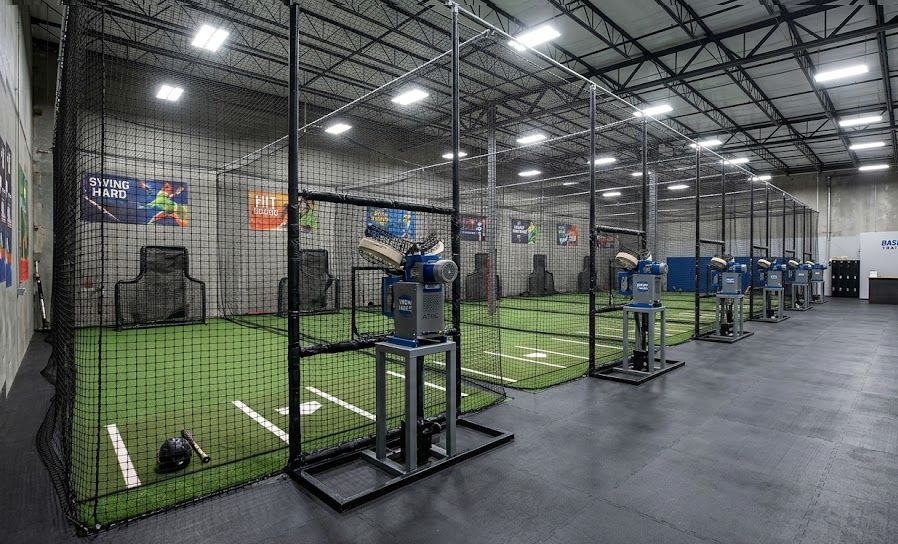
Batting cages can be profitable, and the owners who make real money treat them as a programming business rather than a coin-operated box. Cage rental alone produces modest, steady revenue. Lessons, team rentals, memberships, and birthday parties are what turn a facility into a business worth owning. Profitability comes down to three things: keeping startup costs matched to your market, driving utilization during after-school and weekend hours, and layering higher-margin programming on top of walk-in swings. Here is what the numbers look like on both sides of the ledger.
What Batting Cages Earn
Facilities charge in two main ways: per round of pitches, usually a few dollars for a token or credit, and per half hour of cage rental, commonly $25 to $50 depending on the market. Teams book blocks for practice, families book parties, and instructors rent lanes for lessons, either as employees or as revenue-sharing independents.
The recurring layer matters most. The U.S. batting cages industry generates $3.2 billion across roughly 8,800 businesses, memberships are the largest product segment, and no operator holds a meaningful national share. That last detail is good news for a new owner: this is a local business won on location and programming, not a market dominated by chains.
✓ 6+ months in business
✓ $15,000+ monthly revenue
✓ Active business bank account
What It Costs to Open
Commercial pitching machines run about $3,000 to $15,000 each depending on type, with programmable multi-speed machines at the top of the range. Cage framing, netting, turf, and dividers typically add $2,000 to $10,000 per lane. From there the budget splits sharply by format:
| Format | Typical startup cost | What drives it |
| Outdoor cages, small setup | $50,000 to $150,000 | Machines, netting, site work, fencing, lighting |
| Indoor facility, 4 to 8 cages | $150,000 to $500,000+ | Building lease and build-out, ceiling height, HVAC, machines, lobby |
Outdoor setups cost less and earn less, because weather and daylight cap their calendar. Indoor facilities cost more and require tall clear-span space, but they sell practice time in February, which is exactly when serious players are preparing for spring and when the money is made in most markets.
The Profit Math
Utilization decides everything. Consider an indoor facility with six cages renting at $45 an hour. At an average of four paid hours per cage per day, it grosses about $1,080 daily, or roughly $32,000 a month before lessons, memberships, and parties are added. Against rent, utilities, insurance, payroll for a lean counter staff, and machine maintenance, that facility can produce a healthy margin. Cut the utilization in half, and the same building loses money. That is the entire business in one sentence, and it is why the profitable operators obsess over programming their off-peak hours.
What Separates Profitable Cages from Token Boxes
Location near youth baseball and softball activity comes first, since teams and lesson clients are the repeat revenue. Programming comes second: house instructors, team practice packages, winter training memberships, camps, and parties fill the hours that walk-in traffic never will. Third is the season strategy. Indoor facilities that market hard from January through April capture the pre-season training wave that outdoor operators watch from the sidelines.
Anyone researching how to start a batting cage business should build the plan around those three levers before pricing a single machine, because the same equipment earns wildly different returns depending on the hours it stays busy.
How to Start a Batting Cage Business
The sequence is straightforward. Confirm local demand by counting leagues, travel teams, and training facilities within a short drive. Secure a space with the ceiling height and power for machines, or land with the right zoning for outdoor lanes. Price machines and netting, line up insurance, and build the programming calendar, including lessons and team blocks, before opening day rather than after. Then match financing to the budget so the machines and build-out are funded without draining the operating reserve you will need in the first slow months.
Need Funds Quickly?
Financing a Batting Cage Facility
Pitching machines, cages, and turf qualify for equipment financing, with the equipment itself serving as collateral, which keeps approval accessible even for newer owners. A strong used market exists for pitching machines, and our guide to equipment financing for used equipment explains how lenders handle pre-owned gear, including age limits and down payments. For build-out and opening costs, a short-term loan with a defined payoff matches a defined project, leaving your cash free to run the business.
Finance Your Batting Cage Business with Delta Capital Group
Delta Capital Group provides unsecured working capital from $5,000 to $5,000,000 to business owners across the country. No collateral required beyond the equipment for most equipment financing. Approvals happen in as little as 24 hours, and 95 percent of approved applicants are funded within 48 hours. Minimum qualifications are 6 months in business, $15,000 in monthly revenue, and a 500 credit score. Apply at deltacapitalgroup.com.
Need Funds Quickly?
Frequently Asked Questions
How much does it cost to open a batting cage facility?
Small outdoor setups typically cost $50,000 to $150,000, while indoor facilities with four to eight cages generally run $150,000 to $500,000 or more once build-out is included. Machines and per-lane netting are the core equipment costs, and the building drives the rest.
How much do commercial pitching machines cost?
Roughly $3,000 to $15,000 each. Simple single-speed machines sit at the low end, while programmable machines that throw multiple pitch types and speeds command the premium, and many facilities run a mix.
Are indoor or outdoor batting cages more profitable?
Indoor facilities usually win over a full year because they sell the winter and early-spring training season, when teams and serious players pay for practice time. Outdoor cages cost far less to open but earn only when weather and daylight cooperate.
Can you finance batting cage equipment?
Yes. Pitching machines, netting systems, and turf qualify for equipment financing with the equipment as collateral, and used machines can be financed as well. Owners commonly pair equipment financing with a short-term loan for build-out.
How much do batting cages charge?
Most facilities charge a few dollars per round of pitches and $25 to $50 per half hour for private cage rental, with team blocks, lessons, memberships, and parties priced on top. Local youth sports demand sets the ceiling more than any pricing formula does.

