
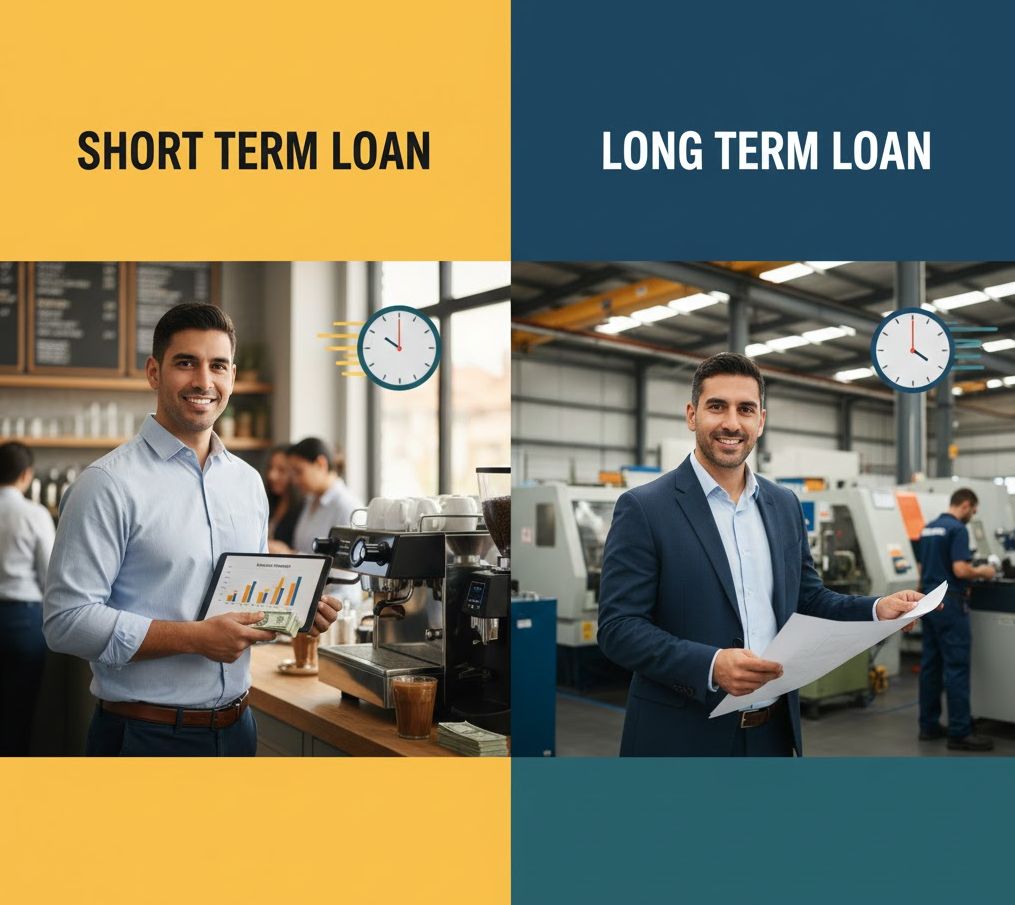
Long term business loans stretch from two to 25 years and suit larger investments like real estate, major equipment, or business expansion.
The right choice depends on what you’re funding, how quickly your investment will generate returns, and what payment structure your cash flow can handle.
Short term loans have higher monthly payments but lower total interest.
Long term loans have lower monthly payments but higher total cost over time.
Neither is universally better. The best loan term matches your specific situation.
Understanding Business Loan Term Lengths
Before comparing options, let’s define what we’re actually talking about.
Loan term refers to how long you have to repay the borrowed amount. It’s one of the most important variables in any financing decision, affecting your monthly payment, total cost, and cash flow impact.
Short Term: 3 to 24 Months
Short term business loans typically range from three months to two years. Some lenders push into the 24 to 36 month range, but anything under three years generally falls into the short term category.
Payments are usually made daily or weekly rather than monthly. This frequent payment structure helps lenders manage risk and ensures steady repayment, but it requires careful cash flow management on your end.
Long Term: 2 to 25 Years
Long term business loans extend from two years up to 25 years depending on the loan type and purpose. SBA loans, commercial real estate loans, and major equipment financing often fall into this category.
Payments are typically monthly, which feels more familiar to most borrowers. The extended timeline means lower individual payments, but you’re paying interest for a much longer period.
The Middle Ground
Some loans fall between these categories. A three-year equipment loan or a five-year working capital loan occupies middle territory. For simplicity, we’ll focus on the clearer short and long term distinctions, but know that options exist across the spectrum.
What Are Short Term Business Loans
Short term loans deliver a lump sum you repay quickly, usually within a few months to two years.
The speed of these loans is a major advantage. As we’ve covered in our guide to how to get a business loan in 24 hours, many short term lenders fund within a single business day. The streamlined process and minimal documentation requirements make this possible.
Common Uses
Short term loans excel for needs that will generate returns quickly or solve immediate problems:
● Purchasing inventory before a busy season
● Covering payroll during a slow period
● Handling unexpected equipment repairs
● Taking advantage of a time-sensitive opportunity
● Bridging cash flow gaps while waiting for customer payments
The trucking company owner featured in 48 Hours: How a Short-Term Loan Saved My Trucking Company used short term funding to solve an immediate crisis that would have shut down operations. That’s the sweet spot for these products.
Typical Terms
● Loan amounts: $5,000 to $500,000
● Repayment period: 3 to 24 months
● Payment frequency: Daily or weekly
● Funding speed: Same day to a few days
● Collateral: Usually not required
Who Qualifies
Short term lenders typically require six months in business and $10,000 to $15,000 in monthly revenue. Credit requirements are flexible, with many lenders approving scores as low as 500. The focus is on your recent business performance rather than your credit history.
What Are Long Term Business Loans
Long term loans provide larger amounts repaid over multiple years, sometimes decades.
These loans are designed for significant investments that take time to pay off. You wouldn’t buy a commercial building with a 12-month loan because the building won’t generate enough return in one year to cover that repayment. Long term financing matches the loan timeline to the asset’s useful life or revenue potential.
Common Uses
Long term loans make sense for major investments:
● Commercial real estate purchases
● Large equipment acquisitions
● Business acquisitions or buyouts
● Major expansion projects
● Franchise purchases
● Significant renovations or build-outs
Typical Terms
● Loan amounts: $50,000 to several million
● Repayment period: 2 to 25 years
● Payment frequency: Monthly
● Funding speed: Weeks to months
● Collateral: Often required
Who Qualifies
Long term loans have stricter requirements. Lenders want to see established businesses with strong financials, good credit, and often collateral to secure the loan. Two or more years in business is common. Credit scores of 680 or higher are typical requirements, though SBA loans sometimes work with lower scores.
The trade-off for stricter requirements is better rates. If you qualify, long term financing is generally cheaper than short term options.
Need Funds Quickly?
Key Differences Between Short and Long Term Loans
Let’s break down the major differences across several dimensions.
Speed of Funding
Short term loans win decisively here. Applications are simpler, documentation is minimal, and funding happens in days or even hours. Long term loans involve extensive underwriting, often requiring weeks or months to close.
If you need money this week, short term is your path. If you can plan ahead, long term options open up.
Qualification Requirements
Short term lenders focus on revenue and cash flow. Credit matters less. Time in business requirements are lower. This accessibility makes short term loans available to businesses that don’t qualify for traditional financing.
Long term lenders want the full picture. Credit scores, financial statements, tax returns, collateral, business plans. The bar is higher, but the terms are better for those who clear it.
Payment Structure
Short term loans typically require daily or weekly payments. This can strain cash flow if you’re not prepared. Imagine a $50,000 loan with daily payments of $250. That’s real money coming out every business day.
Long term loans use monthly payments, which most businesses find easier to manage and plan around.
Total Cost
Here’s where things get counterintuitive. Short term loans often have higher rates than long term loans, yet sometimes cost less in total.
How? Because you’re paying interest for a much shorter period.
Consider a hypothetical example. A $50,000 short term loan at a higher rate paid over 12 months might cost $12,000 in fees and interest. A $50,000 long term loan at a lower rate paid over 5 years might cost $18,000 in total interest despite the “better” rate. The math depends on the specific terms, but the principle holds: paying faster often means paying less overall.
Flexibility
Short term loans are straightforward. Borrow, repay, done. If you need more later, apply again.
Some long term loans include prepayment penalties that make early payoff expensive. Others have rigid terms that don’t adapt to changing circumstances. Read the fine print carefully.
Comparing Monthly Payments and Total Cost
Let’s get concrete with some numbers. These are simplified examples to illustrate the principles.
Hypothetical Scenario: $100,000 Loan
| Factor | Short Term (12 months) | Long Term (5 years) |
| Loan Amount | $100,000 | $100,000 |
| Factor Rate / APR | 1.25 factor | 12% APR |
| Total Repayment | $125,000 | $133,467 |
| Monthly Payment Equivalent | ~$10,417 | ~$2,224 |
| Total Interest/Fees | $25,000 | $33,467 |
In this example, the short term loan costs $8,467 less in total despite the higher rate. But the monthly payment is nearly five times higher. Which is “better” depends entirely on your cash flow situation.
If your business generates $50,000 monthly and can comfortably handle $10,000 payments, the short term option saves money. If that payment would strain operations, the long term option’s lower monthly burden might be worth the extra cost.
The Cash Flow Reality
A 2023 JPMorgan Chase Institute study found that the median small business holds only 27 days of cash reserves. That’s less than a month of operating expenses in the bank.
With margins that thin, a high monthly payment can be dangerous. Missing payments damages your credit, triggers penalties, and can spiral into serious problems. A lower monthly payment might cost more over time but keeps your business stable.
This is why there’s no universal answer to which loan term is better. Your cash flow determines what you can actually handle.
💡 Pro Tip
The smartest funding decisions come from understanding the full cost, not just the monthly amount. Visit our guides for more exclusive tips.
When to Choose Short Term Business Financing
Short term loans make sense in specific situations.
The Need Is Immediate
You can’t wait weeks for bank approval. The opportunity is now or never. Equipment broke and operations are stopped. Payroll is due Friday.
Short term lending exists for exactly these moments. Speed is the product.
The Investment Pays Off Quickly
You’re buying inventory that will sell within months. You’re funding a marketing campaign that will generate returns this quarter. You’re bridging a gap until a client pays their invoice.
When your use of funds will generate returns within the loan term, short term financing aligns perfectly.
You Don’t Qualify for Long Term
Your credit score is below what banks require. You’ve been in business less than two years. You don’t have collateral to pledge. Traditional long term financing isn’t available to you right now.
Short term options from alternative lenders fill this gap. They’re more expensive, but they exist when other doors are closed. As we explored in our guide to business loans with a 500 credit score, accessibility often matters more than rate.
You Want to Build a Track Record
Never borrowed for your business before? A short term loan can establish your borrowing history. Make payments on time, and you’ll have a track record that helps you qualify for better terms next time.
You Prefer Getting Debt Over With
Some business owners simply don’t like carrying debt. A 12-month loan means 12 months of payments and then it’s done. A 10-year loan means a decade of obligation hanging over the business.
The psychological weight of debt is real. If paying it off quickly brings peace of mind, that has value.
When to Choose Long Term Business Financing
Long term loans are the right choice in other situations.
The Investment Takes Time to Pay Off
You’re buying a building. The property will generate value for decades. A 12-month loan to purchase it makes no sense because the building won’t produce enough cash in one year to cover that repayment.
Long term financing matches the loan timeline to the asset’s lifespan. Real estate, major equipment, and business acquisitions all fit this pattern.
Cash Flow Can’t Handle High Payments
Your business is profitable but runs lean. There’s not a lot of slack in the monthly budget. A $2,000 monthly payment is manageable. A $10,000 monthly payment would break you.
Spreading payments over more years reduces the monthly burden, keeping your operations stable.
You Qualify for Better Rates
If you have strong credit, solid financials, and collateral to offer, you can access rates that make long term borrowing genuinely affordable. A 7% rate over 10 years is very different from a 30% effective rate over 12 months.
The Amount Is Large
Borrowing $500,000 with a 12-month repayment would require enormous monthly payments. Large loans almost always need longer terms to create manageable payment structures.
You’re Making a Strategic Investment
Expanding to a second location. Acquiring a competitor. Building out manufacturing capacity. These are strategic moves that transform the business over years, not months.
The investment horizon justifies a longer financing horizon.
Martin’s construction business success story shows how access to capital enabled growth from $1.2 million to $2.8 million in annual revenue. Strategic funding decisions compound over time.
How Loan Purpose Affects Term Selection
Your reason for borrowing should guide your term choice. Here’s a quick framework.
Inventory Purchases: Short Term
Inventory turns over. You buy it, sell it, and use the proceeds to repay the loan. A 90-day or 6-month term matches the inventory cycle.
Equipment Repairs: Short Term
You need the equipment running now. The repair enables ongoing operations. Once it’s fixed, the business generates revenue to repay quickly.
Cash Flow Gaps: Short Term
You’re waiting for clients to pay or bridging a seasonal slowdown. The gap is temporary. Short term financing matches temporary needs.
Major Equipment Purchases: Medium to Long Term
A new CNC machine or delivery truck will last 5 to 10 years. Financing over 3 to 7 years makes sense. You’re paying off the asset over a portion of its useful life.
Real Estate: Long Term
Buildings last decades. A 15 to 25 year loan matches the asset’s longevity and keeps payments manageable relative to the large purchase price.
Business Acquisition: Long Term
Buying another company is a major investment that takes years to fully integrate and realize value from. Long term financing is appropriate.
Working Capital for Growth: It Depends
Need short term cash to fund expanded operations? Short term might work. Need ongoing capital support for a multi-year growth phase? A line of credit or medium-term loan could be better.
Qualification Differences by Loan Term
Your ability to qualify differs significantly between short and long term options.
Short Term Loan Qualifications
● Time in business: 6 months minimum
● Monthly revenue: $10,000 to $15,000+
● Credit score: 500 to 550 minimum at many lenders
● Documentation: Bank statements, ID, basic business info
● Collateral: Usually not required
● Financial statements: Usually not required
Long Term Loan Qualifications
● Time in business: 2+ years typical
● Annual revenue: Often $100,000+ minimum
● Credit score: 680+ for most options
● Documentation: Tax returns, financial statements, business plan
● Collateral: Often required
● Financial statements: Required
The gap in requirements is substantial. Many businesses that qualify easily for short term funding would be declined for long term bank loans. This is why alternative short term lending has grown so dramatically. It serves businesses traditional banks won’t touch.
If you’re building toward long term financing, a business line of credit can help establish your track record while providing flexible access to capital along the way.
How to Decide Which Loan Term Is Right for Your Business
Work through these questions to clarify your decision.
Question 1: What are you funding?
Is it a short term need or a long term investment? Match the loan term to the purpose.
Question 2: How quickly will the investment generate returns?
If returns come within months, short term works. If returns build over years, long term makes sense.
Question 3: What can your cash flow handle?
Be honest. Calculate what different payment amounts would mean for your monthly operations. Don’t overextend.
Question 4: Do you qualify for long term financing?
Check the requirements. If you don’t qualify, short term is your current option. That’s okay. Build your profile and revisit long term later.
Question 5: How fast do you need the money?
Urgent needs require fast funding. Short term lenders deliver. Long term financing takes time you might not have.
Question 6: What’s your comfort level with debt?
Some owners want debt cleared quickly. Others prefer lower payments over longer periods. Both are valid perspectives.
Question 7: What does the total cost comparison show?
Do the math on your specific options. Sometimes the cheaper monthly payment costs more overall. Sometimes paying more per month saves money. The answer depends on the actual terms you’re offered.
Need Funds Quickly?
Frequently Asked Questions About Business Loan Terms
Can I pay off a short term loan early?
Usually yes. Most short term lenders don’t have prepayment penalties, but verify before signing. Paying early can save on interest if your agreement allows it.
What if I can’t decide between short and long term?
Consider a medium-term option if available, or start with a short term loan to prove your business can handle debt. You can pursue longer-term financing later once you’ve established a track record.
Are short term loans always more expensive?
In terms of annual percentage rate, usually yes. In terms of total dollars paid, not always. Paying a higher rate for 12 months can cost less than a lower rate for 60 months.
Can I refinance a short term loan into a long term loan?
Sometimes. If your business improves and you qualify for better financing, refinancing can make sense. Some businesses use short term loans initially, then refinance into longer terms once they’ve built credit and history.
Do long term loans always require collateral?
Not always, but commonly. Unsecured long term loans exist but require excellent credit and strong financials. Most long term financing involves some form of collateral or significant personal guarantee.
What’s the best loan term for a startup?
Startups have limited options. Most long term lenders require two or more years in business. Short term financing from alternative lenders may be available after six months of operation with sufficient revenue.
How do lines of credit compare to term loans?
Lines of credit provide flexible access to capital without fixed repayment schedules. They work well for ongoing needs and cash flow management. Term loans, whether short or long, are better for specific one-time funding needs.

