
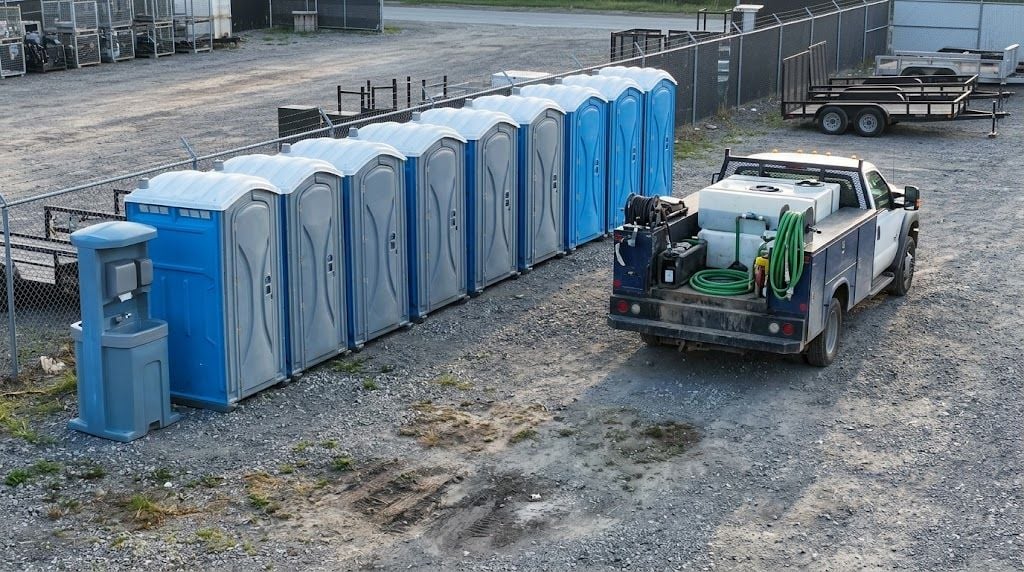
Starting a porta potty rental business takes roughly $78,500 to $248,000 under the planning assumptions in the table below. The service truck and the first fleet of units account for most of it. The business model is recurring rent: you place units at construction sites, farms, events, and other locations, service them on a schedule, and bill monthly or per event. The first budgeting question is how many units you can keep rented.
Delta Capital Group’s current minimums are 6 months in business, $15,000 in monthly revenue, and a 500 credit score, so Delta’s products are aimed at portable sanitation companies that are already operating rather than pre-revenue launches.
How a Porta Potty Rental Business Works
A porta potty rental business owns portable restroom units, places them at customer sites for a rental period, and services them on a set schedule. The rental fee typically covers delivery, routine pumping and cleaning, restocking, and pickup. Construction and other long-term placements produce steady monthly revenue, while events pay more per unit for shorter rentals.
Startup Costs for a Porta Potty Rental Business
| Cost item | Planning range used in this breakdown |
| 40 standard units, new or used | $20,000 to $44,000 |
| 4 ADA-accessible units and 4 hand-wash stations | $8,000 to $14,000 |
| Service truck with waste and freshwater tanks | $35,000 to $140,000 |
| Delivery trailer | $4,000 to $12,000 |
| Chemicals, deodorizer, paper and cleaning supplies (first three months) | $1,500 to $4,000 |
| Registration, hauler permits and insurance down payments | $2,500 to $8,000 |
| Yard deposit, first month’s rent and a wash-down area | $2,000 to $8,000 |
| Website, routing software and phone line | $500 to $3,000 |
| Operating reserve for fuel, disposal fees and payroll | $5,000 to $15,000 |
| Total | $78,500 to $248,000 |
These figures are planning assumptions, not quotes. The truck line drives the range: a used truck with a smaller tank sits near the bottom, and a new purpose-built vacuum truck sits near the top. For a heavier truck, check licensing: in general, a single vehicle rated at 26,001 pounds or more requires a commercial driver’s license, and so can a combination rated at 26,001 pounds or more when the trailer is rated over 10,000 pounds.
Where Demand Comes From
Construction sites are the anchor customer for many operators, and much of that demand traces back to federal workplace rules. Under OSHA’s construction sanitation standard, toilets must be provided according to crew size: one for 20 or fewer workers, one toilet seat and one urinal per 40 workers for 20 or more, and one toilet seat and one urinal per 50 workers for 200 or more. The requirement doesn’t apply to mobile crews with transportation readily available to nearby toilet facilities. OSHA requires qualifying toilet facilities, not rented units specifically, so a site with other compliant facilities may not need yours. Even so, contractor accounts are the core of many route plans, with events, farms, parks, and disaster response as additional lines.
The Route Math
A simplified scenario shows how the pieces fit, though it isn’t a profitability forecast. Imagine an owner with 40 standard units, 32 of them on rent at $165 a month with weekly service. Servicing a unit, counting labor, chemicals, paper, fuel, and disposal, costs her about $15 a visit, or roughly $65 a month across 4.33 weekly visits. Each rented unit then contributes about $100 a month, so 32 rented units contribute about $3,200 a month before the truck payment, insurance, and overhead.
Spread across all 40 owned units, that is about $80 of monthly contribution per unit before the truck, insurance, financing, and overhead, so the actual payback on each unit depends on those costs too. Utilization, meaning the share of units actually on rent, and route density move the numbers most. Units clustered on a few job sites can be serviced in minutes each, while scattered single units eat drive time.
Permits, Disposal and Insurance
Pumped waste has to go somewhere legal, usually a wastewater treatment plant or another permitted facility that charges by the gallon. Many states license or permit anyone who hauls and disposes of portable toilet or septage waste, and some counties add their own requirements. Before you take your first customer, get written confirmation that a specific facility will accept portable toilet waste from you, along with its approval steps, handling rules, and charges, because disposal is a recurring cost on every route.
Commercial auto coverage for the truck and general liability are the core policies, and many states require workers’ compensation once you have employees, and some set a minimum headcount.
Managing Seasonal Cash Flow
In colder regions, construction slows, and outdoor events stop for part of the year, while truck payments, insurance, and winterizing costs keep going. Our guide to seasonal business funding covers ways to plan for that dip.
Contractor accounts can also pay on 30-day terms or longer, which means you service units for a month or more before the first payment arrives. For larger commercial accounts, invoice factoring is one way to turn those receivables into cash sooner.
Finance Your Portable Restroom Fleet with Delta Capital Group
If your portable sanitation company has been operating for at least six months and you’re adding units, a trailer, or a second service truck, Delta Capital Group provides equipment financing and working capital to business owners across the country. Equipment financing is structured around the equipment’s useful life. No collateral is required beyond the equipment for most equipment financing. Approvals happen in as little as 24 hours, and 95 percent of approved applicants are funded within 48 hours. Minimum qualifications are 6 months in business, $15,000 in monthly revenue, and a 500 credit score. Apply at deltacapitalgroup.com.
Frequently Asked Questions
How many porta potties do you need to start a rental business?
There’s no fixed number. Many owners start with a few dozen units and add more as contracts come in, because units sitting in the yard earn nothing.
Do you need a permit to start a porta potty business?
Usually. Beyond a business registration, many states require a license or permit to haul and dispose of portable toilet waste, and disposal facilities often set their own approval steps. Check with your state environmental or health agency and your county before you buy a truck.
Is a porta potty business profitable?
It can be, because rent recurs monthly and units last for years. Profit depends on utilization, route density, disposal costs, and pricing in your market. Run the route math with local prices before committing to a fleet size.
How often are portable toilets serviced?
Weekly service is common for construction and long-term placements, and busy sites may need more. Events are often serviced daily or between days of a multi-day event, depending on attendance.
Can I finance porta potty units and a pump truck?
Yes. Units, trailers, and service trucks are commonly financed as equipment. Delta publishes minimums of 6 months in business, $15,000 in monthly revenue, and a 500 credit score, subject to underwriting, so the fit is an operating company expanding its fleet.
