
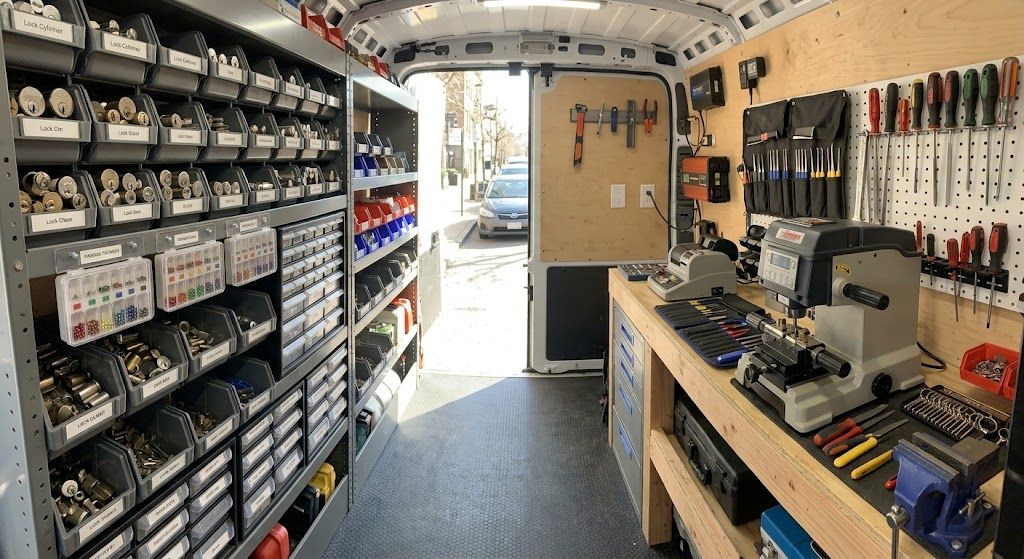
Using the planning assumptions below, a locksmith startup budget can range from roughly $5,000 to $71,000. The range is wide because the trade scales in stages. A residential rekeying and lockout operation run from a car you already own sits at the bottom. A van-based business doing automotive key programming and commercial access control sits at the top.
Worth knowing before you plan the money: Delta Capital Group’s current minimums are 6 months in business, $15,000 in monthly revenue, and a 500 credit score, so Delta’s products are aimed at businesses that are already operating rather than pre-revenue launches.
The Cost Breakdown
| Category | Planning range used in this breakdown |
| Training or apprenticeship | $500 to $5,000 |
| State licensing, background check, and fingerprinting | $100 to $1,500 |
| Bonding and general liability insurance, first year | $800 to $3,500 |
| Core tools: picks, rekeying kits, key duplicator | $1,500 to $8,000 |
| Automotive key programming equipment, optional | $0 to $12,000 |
| Vehicle and interior upfit | $0 to $30,000 |
| Starting lock and key inventory | $1,000 to $5,000 |
| Website, phone, dispatch software and marketing | $1,000 to $6,000 |
| Total | $4,900 to $71,000 |
The two line items that swing the total are the vehicle and the automotive equipment. Skip both at the start and a lean residential operation becomes genuinely affordable.
Licensing Varies by State More Than Most Trades
Some states license locksmiths through a dedicated bureau, require fingerprinting and a criminal background check, and set continuing education requirements. Others impose nothing at the state level and leave it to cities or counties. A few regulate locksmiths under a broader security services statute.
Because the picture differs so much, check with your own state’s licensing authority before budgeting. Guidance written for one state is a poor guide to another, and this is a trade where operating without a required license carries real consequences.
Tools: Where to Start and What to Defer
The starting kit is smaller than most people expect. Pick sets and tension tools, a rekeying kit with pinning trays for the cylinder brands you will see locally, a key duplicator, a plug follower, basic hand tools, and a starting stock of pins, cylinders, and blanks.
What to defer: automotive key programming equipment, safe manipulation tools, and specialized commercial hardware. These are the expensive categories, and each should wait until you have demand you are turning away. Automotive work in particular carries ongoing subscription and software update costs on top of the hardware.
A key duplicator and a small inventory can add revenue to the same service call by turning a visit into a same-visit sale. That is the purchase to make early.
“Got funded in under 24 hours. The process was straightforward and my rep walked me through everything.”
The Vehicle Decision
Starting out of a car you already own can be one of the largest startup savings, and it works fine for residential rekeying and lockouts. The limits show up when you take on commercial work, where you need to carry a wider range of hardware and want a workbench.
When the van becomes necessary, it may not have to be a cash purchase. Eligible vehicles and associated equipment may be financeable depending on the lender and transaction, with the asset itself serving as the security. Mobile trades share this pattern, and our breakdown of starting a car detailing business covers similar ground on vehicles and equipment.
What the Trade Pays
Locksmithing is a small, skilled trade. According to O*NET, which publishes Department of Labor occupational data, locksmiths and safe repairers numbered about 18,800 employees in 2024, with median wages of $24.68 hourly and $51,320 annually in 2025.
Those figures describe employed locksmiths rather than business owners. An owner keeps the margin on parts and on every call, but also carries the vehicle, insurance, and marketing costs that an employee does not, so owner economics look different from employee wages.
Funding the Business Once It Is Running
Two needs come up repeatedly after the first year. Inventory expands as you take on more lock brands, and the van either needs replacing or upfitting. Equipment financing suits the van and the larger tools. A working capital loan or line of credit suits inventory and short-term cash-flow gaps.
Credit history is often the constraint for tradespeople who have run the business on personal cards. Our guide to business loans with a 500 credit score covers what is realistic there.
| Feature | Unsecured | Secured |
|---|---|---|
| Collateral | None | Required |
| Approval Speed | 24-48 hrs | 2-4 weeks |
| Credit Score | 500+ | 650+ |
Fund Your Locksmith Business with Delta Capital Group
Delta Capital Group provides unsecured working capital from $5,000 to $5,000,000 to business owners across the country, along with equipment financing structured around the equipment’s useful life. No collateral required beyond the equipment for most equipment financing. Approvals happen in as little as 24 hours, and 95 percent of approved applicants are funded within 48 hours. Minimum qualifications are 6 months in business, $15,000 in monthly revenue, and a 500 credit score. Apply at deltacapitalgroup.com.
Frequently Asked Questions
Can you start a locksmith business with no money?
Not entirely. Even with a vehicle you already own, a new operation generally needs some budget for tools, registration or licensing where required, insurance, and inventory. Under the planning assumptions above, roughly $5,000 is a reasonable lean starting budget. Starting with residential rekeying keeps the tool list short.
Do you need a license to be a locksmith?
It depends entirely on your state. Some require a state license with fingerprinting and background checks, others regulate at the city level, and some do not regulate the trade at all. Check your state’s licensing authority directly rather than relying on general guidance.
Is automotive locksmithing worth the equipment cost?
Automotive locksmithing can produce higher-ticket jobs, but it also requires substantially more equipment and software investment, including ongoing subscriptions. Many owners add it once residential and commercial work is steady enough to cover the payment.
How long before a locksmith business is profitable?
The cost base is light compared with most trades, but there is no reliable universal timeline. What takes longest is usually building the call volume and referral relationships with property managers and real estate agents that produce steady work.
Can I finance locksmith tools and a van?
Yes, once the business meets a lender’s minimums. Equipment financing uses the van and the tools as security, so the financed asset can strengthen the lender’s collateral position, but approval still depends on underwriting.

