
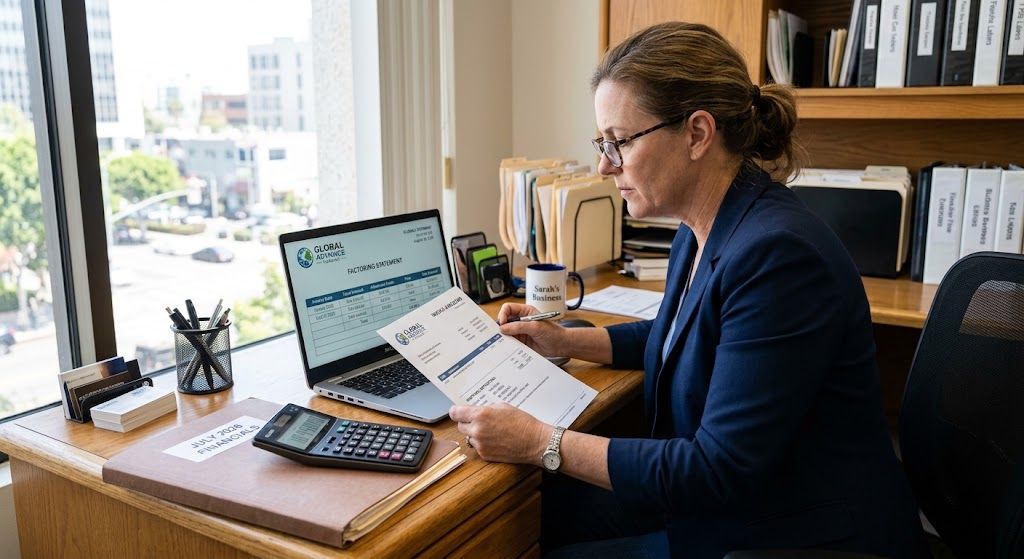
A lockbox account in invoice factoring is a dedicated bank account, controlled by the factoring company, that your customers pay into instead of paying you directly. The factor collects the payment, applies it against the advance it already gave you, deducts its fee, and releases the remainder. The account exists so the factor controls the cash it has already funded, rather than relying on you to forward payments after they arrive.
Many factoring facilities use some version of this mechanism, though structures vary and the paperwork may call it something else. Understanding who holds the account and whose name appears on the remittance instructions tells you more about a factoring agreement than the advance rate does.
How the money actually moves
The sequence is straightforward once the account is in place. You invoice your customer as normal. The remittance instructions on that invoice direct payment to the lockbox rather than to your operating account. The factor advances you a percentage of the invoice face value, commonly 70 to 90 percent, usually within a day or two. Your customer pays the lockbox on their own schedule. When that payment lands, the factor applies it against your advance, takes its fee, and releases the reserve balance to you.
The reserve is the part worth watching. If a factor advances 85 percent, the remaining 15 percent is held until the customer pays. The reserve is credited to you, but it stays subject to fees, chargebacks, offsets and any other adjustments your agreement allows, and the release timing is set by the contract rather than by when the cash arrives.
✓ 6+ months in business
✓ $15,000+ monthly revenue
✓ Active business bank account
Lockbox, notification, and who your customer thinks they are paying
Lockbox arrangements interact directly with whether your customer knows factoring is involved.
In a standard notification facility, the customer receives a notice of assignment and pays a clearly identified factoring company. The lockbox is in the factor’s name and there is no ambiguity.
Non-notification arrangements vary. One common structure uses an account held in a name resembling your own business, so the customer sees no obvious sign of a third party. In others the customer continues paying you directly and you remit to the factor on an agreed schedule. The mechanics are covered in more detail in our explanation of non-notification factoring. The point to take from it is that confidentiality and collection control are separate design choices.
A quick note on terminology. Lockbox also appears in merchant cash advance repayment, where it describes a bridge account used to split card settlement between the merchant and the funder. That is a different mechanism serving a different product. The factoring lockbox described here collects customer invoice payments; the MCA version splits card receipts.
| Arrangement | Whose name is on the account | Customer awareness |
| Notification factoring | Factoring company | Explicit, via notice of assignment |
| Non-notification factoring | Varies: an account resembling your business, or payment direct to you | Usually none |
| No lockbox, direct pay to you | Yours | None, but you must forward payments |
Why factors insist on it
Two reasons, and both are about risk rather than convenience.
The first is misdirected payment. If a customer pays you directly on an invoice a factor has already funded, factoring agreements generally require you to forward those proceeds promptly, and retaining or spending them may constitute a breach. A repeated pattern can trigger default. The lockbox removes the opportunity for that to happen by accident.
The second is visibility. A factor holding the collection account sees payment behaviour in real time: who pays on schedule, who has slipped from 30 days to 55, and which accounts are being disputed. That information feeds directly into advance rates and which customers the factor will continue to fund.
Industry data underlines why collection discipline matters at scale. The Secured Finance Network reported days sales outstanding of 46.8 days alongside factoring volume growth of 16.6 percent year over year in its 2025 year-end survey. A factor funding against invoices that take roughly seven weeks to pay has a strong interest in knowing exactly when the cash lands.
Need Funds Quickly?
What to check before you sign
Four questions are worth asking directly, because the answers vary more between factors than most business owners expect.
Who legally owns the lockbox account, and what happens to funds sitting in it if the factor enters administration? Ask for the answer in writing.
How quickly is the reserve released after the customer pays? Same day, two business days, and weekly batch are all common, and the difference materially changes your working capital position.
What happens to overpayments and payments on invoices you never factored? Customers frequently pay a single lump sum covering several invoices. Confirm how unapplied cash is identified and returned.
Can you see the account? Some factors provide a live portal showing incoming payments; others send a weekly statement. Imagine a business owner trying to answer a customer’s question about whether their payment cleared, three days after it was sent, with no visibility into the account it was sent to. That is a service problem the agreement can prevent.
Turn Unpaid Invoices into Working Capital with Delta Capital Group
Delta Capital Group provides unsecured working capital from $5,000 to $5,000,000 to business owners across the country. Approvals happen in as little as 24 hours, and 95 percent of approved applicants are funded within 48 hours. Minimum qualifications are 6 months in business, $15,000 in monthly revenue, and a 500 credit score. Apply at deltacapitalgroup.com.
If you are weighing factoring against other options, our overview of invoice factoring for small business covers how advance rates, fees, and reserves fit together across a full facility.
Get Your Free Quote
Frequently asked questions
Is a lockbox account required for invoice factoring? Not universally, though many facilities use one. Factors that allow payment directly to you often price differently or restrict which customers they will fund, because they carry more exposure to misdirected payment.
Who controls the money in a factoring lockbox? The factoring company controls the account. Funds are applied against your outstanding advance first, with the reserve balance released to you under the terms of your agreement.
Will my customers know I am using a factoring company? In a notification facility, yes, because they receive a notice of assignment. Non-notification arrangements are designed to avoid that, using either an account named to resemble your business or continued direct payment to you, depending on the structure.
What happens if a customer pays me directly instead of the lockbox? Factoring agreements generally require those proceeds to be forwarded promptly, and retaining them may constitute a breach. Tell your factor as soon as it happens rather than waiting for reconciliation to surface it.
Is a factoring lockbox the same as an MCA lockbox? No. A factoring lockbox collects customer payments on assigned invoices. In a merchant cash advance, a lockbox or bridge account splits card settlement between the merchant and the funder. Different products, different mechanics.

