
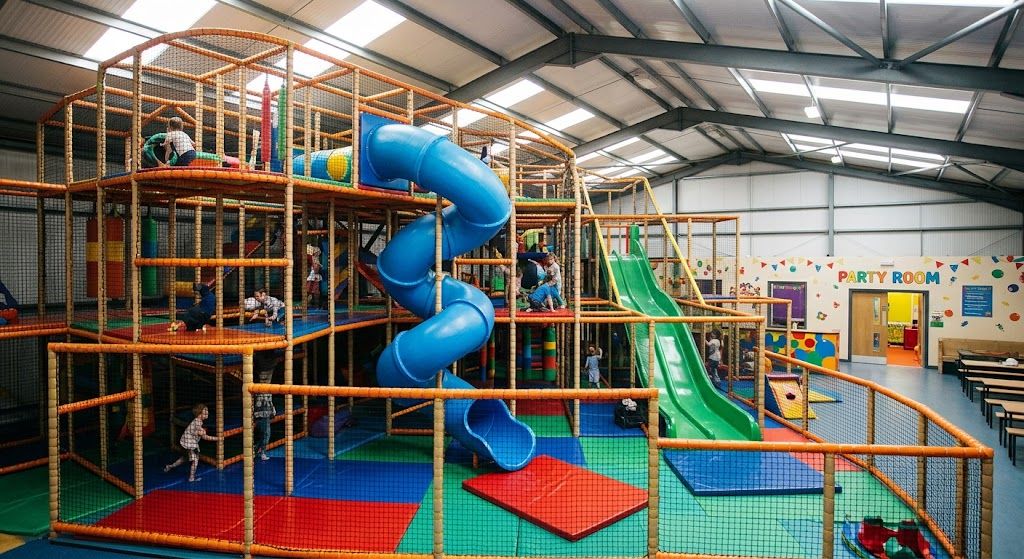
Opening an indoor playground typically costs between $200,000 and $670,000, with most independent operators spending around $300,000 for a 5,000 to 10,000 square foot venue. The play structure itself is the single largest purchase, commonly $60,000 to $250,000 installed, and it is followed closely by build-out, since these venues need ceiling height, flooring, and sightlines that ordinary retail space rarely provides as found.
An indoor playground is a paid-admission recreation venue built around soft play structures, climbing equipment, slides, and toddler areas, earning revenue from walk-in admissions, memberships, and private party bookings. Parties are the part that matters financially. A venue charging $12 to $18 per child at the door commonly earns somewhere between 20 and 35 percent of total revenue from booked parties, and venues that fill weekend slots consistently can push higher. Party revenue carries better margins than open play.
The play structure and the space it needs
Soft play structures are priced by volume and complexity. A modest toddler-focused structure starts around $60,000. A multi-level system with tube slides, ball cannons, and a climbing wall runs $150,000 to $250,000 installed. Manufacturers usually quote installation separately, and lead times of eight to sixteen weeks are normal, which affects when the lease clock starts relative to opening day.
Ceiling height governs what you can buy. Multi-level structures generally need 16 to 20 feet of clear height, and clear height means below ducting and sprinklers rather than to the roof deck. A unit advertised at 18 feet may deliver 14 usable feet once mechanical systems are accounted for, and discovering that after signing is an expensive way to learn it.
Flooring is the second build-out line. Impact-attenuating surfacing under and around structures costs $6 to $15 per square foot, and fall-height requirements drive the specification. Excluding party rooms and the cafe, which are costed separately below, build-out commonly reaches $60,000 to $180,000 once restrooms sized for family traffic are included.
| Cost area | Typical range |
| Play structure, installed | $60,000 to $250,000 |
| Build-out and safety flooring, excluding party rooms and cafe | $60,000 to $180,000 |
| Lease deposit and first rent | $15,000 to $45,000 |
| Party rooms and cafe fit-out | $20,000 to $70,000 |
| Insurance, year one | $8,000 to $25,000 |
| Working capital before break-even | $40,000 to $100,000 |
Insurance and supervision drive the operating model
Insurance for a children’s recreation venue is expensive and heavily conditioned. Carriers price on structure type, fall heights, supervision ratios, and waiver practice, and expect $8,000 to $25,000 in year one. Many policies require documented staff positioning, incident logging, and daily equipment inspection. Those requirements are not paperwork; they are what keeps the premium payable at renewal.
There is a distinction worth being precise about. An indoor playground is a supervised recreation venue where a parent or guardian remains present and responsible. That is a different regulatory category from licensed childcare, where an operator takes custody of children. Drop-off play, unaccompanied minors, and anything resembling scheduled care can move a venue into licensed childcare territory, with staff certification, ratio, and background check requirements attached. Operators who add a drop-off option later sometimes cross that line without realising it, so confirm the local definition before advertising the service.
A genuinely small industry
The U.S. indoor play center sector is approximately $1.0 billion in 2026 across just 766 businesses. That is a small industry by any measure, and the implication cuts both ways.
On the favourable side, most metropolitan areas support only a handful of venues, and a well-located site can hold a catchment with little direct competition. On the unfavourable side, there is limited operating benchmark data available, and a new operator has fewer comparable businesses to learn from than someone opening a restaurant or a gym. Realistic revenue modelling therefore depends more on local party demand and school calendars than on national averages.
Seasonality is pronounced and runs opposite to outdoor recreation. Winter and rainy months are peak. Summer is the trough, and many venues run camps or extended party hours specifically to cover it. Structured camp programmes can attract childcare licensing requirements of their own depending on how they operate, so check before scheduling one. Imagine a venue billing $85,000 in February and $28,000 in July against rent and insurance that do not move, and the shape of the cash flow problem becomes clear.
Get Your Free Quote
Funding an Indoor Playground Once It Is Open
Delta Capital Group funds operating venues rather than pre-revenue startups. Minimum qualifications are 6 months in business, $15,000 in monthly revenue, and a 500 credit score, so the products below apply to a venue that is already trading and wants to expand its structure, add party capacity, or smooth out seasonality.
Delta Capital Group provides unsecured working capital from $5,000 to $5,000,000 to business owners across the country. No collateral required beyond the equipment for most equipment financing. Approvals happen in as little as 24 hours, and 95 percent of approved applicants are funded within 48 hours. Apply at deltacapitalgroup.com.
Operators expanding a play structure typically use equipment financing, while those bridging the summer trough tend toward a business line of credit. The $5,000 to $5,000,000 range describes Delta’s overall funding, not the limit on any single product. Owners weighing a comparable build in the same category can also review our breakdown of trampoline park startup costs.
Frequently asked questions
How much does it cost to open an indoor playground? Most independent operators spend $200,000 to $670,000, with around $300,000 typical for a 5,000 to 10,000 square foot venue. The play structure and build-out together account for the majority of it.
How much ceiling height does an indoor playground need? Multi-level structures generally require 16 to 20 feet of clear height measured below sprinklers and ducting. Toddler-only structures can work in 12 to 14 feet.
Are indoor playgrounds profitable? They can be, with profitability usually driven by party bookings rather than open play admissions. Parties commonly account for 20 to 35 percent of revenue at better margins, so venues that fill weekend slots consistently tend to perform well.
Do I need a childcare license to run an indoor playground? Often not, but licensing definitions vary by state and municipality, and parent presence alone should not be assumed to guarantee an exemption. Drop-off care and some structured programmes can move a venue into licensed childcare, which carries staff ratio, certification, and background check requirements. Confirm the definition locally before advertising any service.
How long until an indoor playground breaks even? Twelve to twenty-four months is common. Party bookings build through word of mouth and school networks, so revenue tends to ramp over several seasons rather than at opening.

